


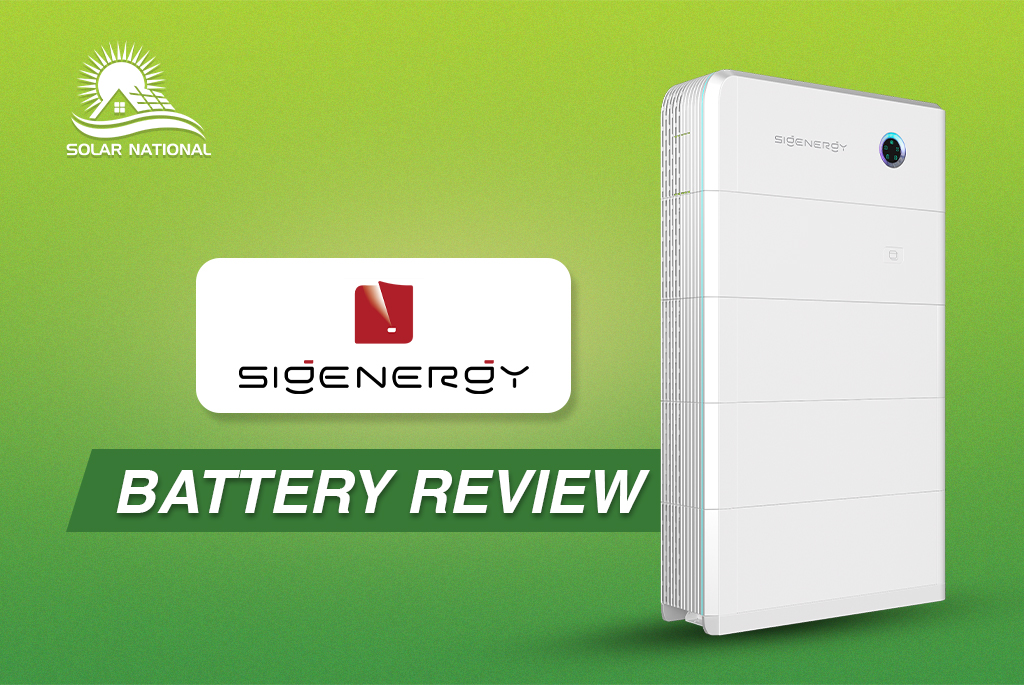
Sigenergy has gone from an unknown name to one of the most talked-about premium battery brands in Australia in under three years. The pitch is unusual: instead of a plain battery, the SigenStor packs a hybrid inverter, battery modules, an optional DC EV charger and an AI energy manager into one tower. We install SigenStor systems across Sydney, so this review is written from real jobs, not a brochure.
The short version: SigenStor is a genuine premium, all-in-one system that suits homeowners who want high efficiency, big expandable capacity, strong backup and EV-charging headroom, and who are comfortable paying more for it. It is not the cheapest option, and we explain who should look elsewhere further down.
What is the Sigenergy SigenStor?
Sigenergy is an energy-technology company founded in 2022 by the engineering team that previously led Huawei’s inverter division. In a few short years it has shipped more than 300 MWh of storage across 40+ countries and set up an R&D centre in Melbourne to tune its software for the Australian National Electricity Market. That pedigree is a big part of why the hardware feels more mature than the company’s age suggests.
The SigenStor combines five things in one minimalist tower:
- A high-efficiency hybrid inverter (single-phase or three-phase)
- Lithium iron phosphate (LFP) battery modules
- A battery power-conversion system with per-module DC-DC optimisers
- An optional DC EV charger for fast, solar-fed vehicle charging
- An AI energy management system controlled through the mySigen app
Because the inverter, gateway and energy manager are pre-integrated, you avoid the compatibility headaches of mixing brands and keep conversion losses low. That integration is also why SigenStor sits at the premium end of the market.
Sigenergy battery models and specs (2026)
SigenStor uses two module sizes in Australia: 6 kWh and 8 kWh, both built on prismatic LFP cells. A single tower accepts up to six modules, so usable capacity scales from around 6 kWh up to 54 kWh per stack with no external cabling. For larger homes and small commercial sites, multiple stacks can run in parallel for well over 100 kWh.
The base holds either a 5 kW single-phase inverter or a 10 to 30 kW three-phase inverter, so the same platform suits a suburban home or a small winery. Being a hybrid, it connects on the DC side of new panels or in AC-coupled mode to an existing array, so you can retrofit it without replacing your current setup.
| Specification | Detail |
|---|---|
| Module sizes | 6 kWh and 8 kWh (prismatic LFP) |
| Capacity per stack | Up to 54 kWh (6 modules) |
| Multi-stack | Parallel stacks for 100 kWh+ |
| Inverter | 5 kW single-phase or 10-30 kW three-phase (built in) |
| DC round-trip efficiency | 94-95% (TUV Rheinland tested) |
| Depth of discharge | 100% |
| Chemistry | LiFePO4 (LFP) |
| Operating temperature | -20°C to 60°C |
| Ingress protection | IP66 (outdoor rated) |
| Backup switchover | Near-instant with Energy Gateway |
| EV charging | Optional 25 kW DC module (V2H/V2G ready) |
| Standards | AS4777.2:2020 compliant, CEC listed |
| Warranty | 10-year product and performance (70% capacity retention) |
Sigenergy inverter and performance
The built-in hybrid inverter is the part that sets SigenStor apart from a plain battery. It handles high DC input across multiple MPPTs, which helps on Australian roofs where panels sit at different angles or catch afternoon shade. Independent TUV Rheinland testing and live cloud data put DC round-trip efficiency at 94 to 95%, a few points above the Australian fleet average, so you lose only around 5 cents of every solar dollar you store.
Charge and discharge run at a strong 1C rate, meaning an 8 kWh module can deliver 8 kW for an hour. That is genuinely useful for induction cooktops or a fast EV top-up. Backup switchover through the Energy Gateway is near-instant, and the system keeps working from -20°C up to 60°C, so it copes with everything from an alpine shack to a Darwin terrace.
Sigenergy battery price in Sydney (2026)
Solar National installs SigenStor systems across Sydney with the federal battery rebate applied at point of sale, no paperwork on your end. Prices below include CEC-accredited installation, the all-in-one SigenStor unit (hybrid inverter plus battery), mySigen app setup and the 10-year warranty.
| Usable capacity | Full price | Federal rebate | You pay |
|---|---|---|---|
| 16 kWh | $12,100 | -$4,120 | $7,980 |
| 24 kWh | $14,000 | -$5,400 | $8,600 |
| 32 kWh | $18,000 | -$6,200 | $11,800 |
| 40 kWh | $22,000 | -$6,560 | $15,440 |
| 48 kWh | $25,500 | -$6,900 | $18,600 |
The SigenStor price includes the built-in hybrid inverter, AI energy management and the option to add a 25 kW DC EV charger, so there is no separate inverter cost to add on top. For reference, component pricing sits roughly at $3,500 to $9,000 for the hybrid controller (with EMS), around $4,500 for an 8 kWh module, about $2,990 for the Energy Gateway backup switch, and $6,500 to $7,500 for the optional DC charger.
Prices are current as at July 2026 and shift with rebate step-downs and switchboard work. We confirm your exact figure at quote stage.
The federal battery rebate in 2026
The Cheaper Home Batteries Program launched on 1 July 2025. From 1 May 2026 it moved to a tiered structure, stepping down over time as national installation volumes hit set thresholds, with further reductions every six months. A typical residential SigenStor stack still receives close to the original per-kWh subsidy on most of its capacity, but the rebate shrinks the longer you wait. To qualify, the system must be 5 to 100 kWh, CEC-listed, and installed by a CEC-accredited installer. SigenStor meets these, and Solar National handles the rebate at point of sale.
Warranty and reliability
Sigenergy offers a 10-year product and performance warranty, guaranteeing at least 70% of original usable capacity, or a throughput figure per module, whichever comes first. That works out to roughly 6,000 full cycles, around 15 years of typical daily use. LFP chemistry, per-module monitoring, arc-fault detection and active cooling all support a long, safe service life in Australian heat.
The honest caveat: Sigenergy is a young brand, founded in 2022. The hardware is well specified and the Melbourne R&D presence is reassuring, but with any newer brand, installer quality and local support matter more than usual. Choosing an installer who actually works with SigenStor day to day is part of protecting that 10-year commitment.
Pros and cons
Pros
- All-in-one design: inverter, battery, EMS and optional EV charger in one tower, fewer components and a neater install
- High efficiency: 94-95% DC round-trip, above the market average
- Genuinely modular: scale from 6 kWh to 54 kWh per stack, and beyond with parallel stacks
- Strong backup: near-instant switchover with the Energy Gateway
- Fast EV charging option via the 25 kW DC module
- Premium control software through the mySigen app
Cons
- Premium price: noticeably more upfront than value brands like Fox ESS
- Younger brand: founded 2022, shorter local track record than Tesla or Sungrow
- Best value comes from the full stack; the EV charger is an optional extra, not standard
Sigenergy vs Tesla Powerwall 3 vs Sungrow
| Sigenergy SigenStor | Tesla Powerwall 3 | Sungrow SBR HV | |
|---|---|---|---|
| Usable capacity | 6-54 kWh/stack | 13.5 kWh fixed | 3.2 kWh/module |
| DC round-trip efficiency | 94-95% | ~89% | ~94.5% |
| Built-in inverter | Yes (hybrid) | Yes (integrated) | No (separate) |
| EV DC charging | Optional 25 kW module | No | No |
| Warranty | 10 yr / 70% | 10 yr / 70% | 10 yr / 70% |
| Positioning | Premium all-in-one | Premium, brand confidence | Value, Sungrow inverter owners |
Our take: SigenStor wins on efficiency, scalability and EV integration. Tesla Powerwall 3 wins on brand confidence and the widest VPP support. Sungrow SBR is the value pick, especially for existing Sungrow inverter owners. If you want a cheaper modular option and do not need the premium software, our Fox ESS review covers a strong budget alternative. We install all of these, so the recommendation follows your usage data, not our stock.
Who should choose Sigenergy?
SigenStor makes the most sense if you:
- Need more than 13.5 kWh of storage now, or plan to expand later
- Live somewhere with frequent outages and want near-instant backup
- Plan to charge an EV quickly from solar using the DC module
- Prefer a single-vendor stack with fewer future maintenance headaches
A worked example: a home with a 10 kW solar system and high evening use adds a 16 kWh solar battery in Sydney. Grid imports drop from around 22 kWh a day to roughly 6 to 9 kWh once daytime solar is stored and used at night. On a blended avoided-import rate of 30 to 35 cents per kWh, that is roughly $1,400 to $1,900 a year off the bill, for a payback in the 7 to 10 year range depending on configuration.
Our verdict
The SigenStor is a genuinely premium, futureproof energy system. Its all-in-one architecture, high efficiency, deep scalability and EV-charging headroom put it among the strongest options in Australia in 2026. The upfront cost is above average and the brand is young, but for medium to large households that value backup, low grid reliance and premium control software, the value case holds up. Where a cheaper or more established brand suits you better, we will say so at the quote. Get a free quote and rebate assessment for your Sydney home.
Frequently asked questions
Is the Sigenergy battery good for Australian homes?
Yes, especially for homes wanting premium, modular storage with strong backup and EV charging. SigenStor uses LFP chemistry, is IP66 rated for outdoor use, runs from -20°C to 60°C, and delivers 94-95% round-trip efficiency. It is a premium option rather than a budget one.
How much does the Sigenergy battery cost in Australia?
Through Solar National in Sydney, SigenStor systems start at $7,980 out of pocket for 16 kWh after the federal rebate, up to $18,600 for a 48 kWh stack. Component pricing runs roughly $3,500 to $9,000 for the hybrid controller, about $4,500 per 8 kWh module, and $2,990 for the Energy Gateway.
What is the Sigenergy battery warranty?
Sigenergy offers a 10-year product and performance warranty, guaranteeing at least 70% capacity retention, equal to roughly 6,000 cycles or about 15 years of typical daily use.
What size do Sigenergy battery modules come in?
SigenStor uses 6 kWh and 8 kWh LFP modules. A single tower takes up to six modules for up to 54 kWh usable, and multiple stacks can run in parallel for 100 kWh or more.
Can Sigenergy work with existing solar?
Yes. The built-in hybrid inverter connects on the DC side of new panels or in AC-coupled mode to an existing array. Compatibility depends on your current inverter setup, which we check at the site inspection.
Is Sigenergy good for backup power?
Yes. With the Energy Gateway, SigenStor provides near-instant backup switchover and strong outage performance, which is one of the main reasons Sydney homes in outage-prone areas choose it.