





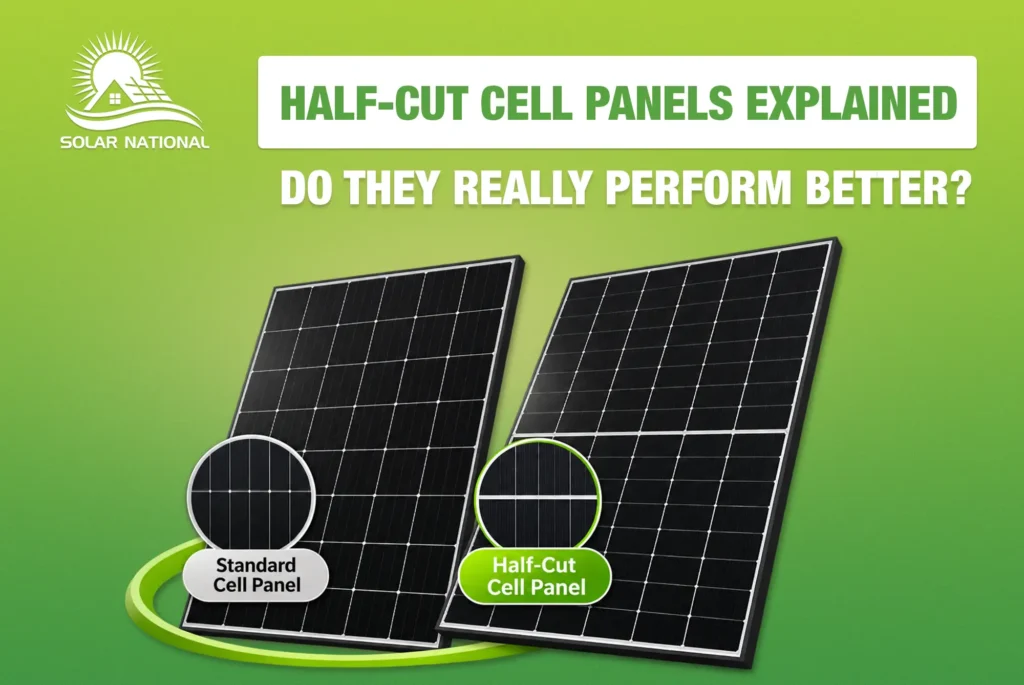
If you have compared solar quotes recently, chances are every panel on the shortlist uses half-cut cell technology. It has become the standard in residential solar, quietly replacing the older full-size cell design across virtually every major manufacturer’s product line. But while the term “half-cut” appears on spec sheets and sales brochures everywhere, most homeowners have no clear idea what it actually means or whether it genuinely makes a difference to the power their system produces.
The short answer is yes, half-cut cell panels do perform better than their full-size predecessors, and the reasons are rooted in straightforward electrical engineering rather than marketing spin. This guide explains exactly how the technology works, why it matters for real-world performance on Sydney rooftops, and what you should look for when comparing half-cut cell panels on your next solar quote.
What Is a Half-Cut Cell Solar Panel?
A conventional solar panel is made up of a grid of individual silicon solar cells, typically 60 or 72 cells for residential and commercial modules. In a traditional full-size cell panel, each of those cells is a single, whole wafer of silicon.
A half-cut cell panel takes the same silicon wafers and slices each one precisely in half using a laser cutter before they are assembled into the panel. So instead of 60 full-size cells, the panel contains 120 half-size cells. Instead of 72, it contains 144.
The cells themselves are still made from the same monocrystalline or polycrystalline silicon. The laser cutting process does not change the material or the fundamental way the cell converts sunlight into electricity. What it changes is the electrical architecture of the panel, and that is where the performance gains come from.
Because each cell is half the size, it produces half the current of a full-size cell. Lower current flowing through each cell and each connection point inside the panel leads directly to lower resistive losses, better shade tolerance and reduced risk of hot spots. Those three benefits are the core of why half-cut cell panels outperform older designs.
How Half-Cut Cells Reduce Resistive Losses
Every solar cell produces an electrical current when sunlight hits it. That current flows through the cell, along the bus bars (the thin silver lines visible on the cell surface), through the ribbon connectors between cells, and eventually out to the inverter. At every point along that path, a small amount of energy is lost as heat due to electrical resistance. These are called resistive losses, or I-squared-R losses in engineering terms.
The amount of energy lost to resistance increases with the square of the current. This means that doubling the current quadruples the resistive loss. Conversely, halving the current reduces resistive loss to just one quarter.
This is exactly what half-cut cells achieve. By splitting each cell in half, the current flowing through each cell is halved. The panel is then wired so that the top half and bottom half operate as two independent electrical circuits connected in parallel. Each circuit carries half the current of a full-size cell design, which cuts the internal resistive losses by roughly 75 percent within the cell strings.
In practical terms, this translates to a measurable increase in the panel’s real-world power output compared to an equivalent full-size cell panel. The gain is typically in the range of 2 to 3 percent under standard conditions, and it widens further in high-temperature environments where resistive losses are amplified.
Better Shade Tolerance
Shade performance is where half-cut cell panels show their most noticeable advantage over older designs, and it is particularly relevant for homes in Sydney where trees, neighbouring buildings, antennas and chimney stacks can cast partial shadows across sections of the roof.
In a traditional full-size cell panel, the cells are wired in a single series string (or two or three strings with bypass diodes). If shade falls on even one cell in a string, the output of that entire string drops dramatically because the shaded cell becomes a bottleneck, restricting the current flowing through every other cell connected to it.
Half-cut cell panels solve this problem through their split-string architecture. The panel is divided into an upper half and a lower half, each operating as an independent electrical circuit. If shade falls on the bottom row of cells, only the lower half of the panel is affected. The upper half continues producing at full capacity. This means you lose roughly half the panel’s output in a partial shade scenario rather than losing nearly all of it.
For Sydney homeowners with rooftops that experience morning shade from a neighbouring house or afternoon shade from a tall tree, this difference can add up to a meaningful improvement in daily energy production across the year.
Improved Durability and Lower Hot Spot Risk
Hot spots are one of the leading causes of long-term panel degradation and, in severe cases, panel failure. A hot spot occurs when a shaded or damaged cell in a string cannot pass current as efficiently as its neighbours. The current from the other cells forces its way through the underperforming cell, generating concentrated heat that can damage the encapsulant, discolour the backsheet, and permanently degrade the cell.
Because half-cut cells carry lower current, the energy dissipated at a problem cell is significantly reduced. Less current means less heat buildup at the point of resistance, which lowers the risk of hot spot formation. Over a 25-year panel lifespan, this improved thermal behaviour contributes to slower degradation and more consistent long-term output.
The physical durability of the cells also benefits. Smaller cells are less prone to micro-cracking during manufacturing, transport and installation because the mechanical stress on each cell is distributed across a smaller surface area. Micro-cracks that develop in full-size cells can grow over time due to thermal cycling (the daily expansion and contraction of the panel as it heats up and cools down), eventually reducing the cell’s performance. Half-cut cells experience less mechanical stress per cell, which helps keep micro-crack propagation in check.
Half-Cut vs Full-Size Cells: Real-World Performance Difference
The theoretical benefits are clear, but how much of a difference does half-cut cell technology make in practice?
Under ideal, unshaded conditions on a mild day, the performance gap between a half-cut panel and an equivalent full-size cell panel is modest, typically 2 to 3 percent. That is because resistive losses are a relatively small fraction of total losses when the panel is operating at moderate temperatures with no shading.
The gap widens in two situations that are extremely common on Sydney rooftops. The first is high temperature. On a 35-degree summer day, rooftop panel temperatures can exceed 65 degrees Celsius. At those temperatures, resistive losses increase, and the half-cut design’s lower internal current delivers a proportionally bigger advantage. The second is partial shading. Even a thin shadow from an antenna, vent pipe or power line crossing part of the array will cause a larger production loss on a full-size cell panel than on a half-cut panel with the same shadow pattern.
Over the course of a full year in Sydney, accounting for hot summer days, morning and afternoon shade from neighbouring structures, and the inevitable accumulation of bird droppings or leaf debris on portions of the array, half-cut cell panels consistently outperform full-size cell equivalents by a measurable margin. For a typical 6.6kW residential system, this can translate to an additional 100 to 300 kWh of generation per year, depending on the specific conditions.
Half-Cut Cell Panels and Sydney Rooftop Conditions
Sydney’s climate makes the case for half-cut cell panels particularly strong.
Summer temperatures regularly push rooftop panel surface temperatures into the 60 to 70 degree range. Under these conditions, every reduction in internal resistive loss counts, and half-cut cells deliver exactly that. Panels with a lower temperature coefficient paired with half-cut cell architecture perform noticeably better through Sydney’s hottest months compared to full-size cell alternatives.
Partial shading is also widespread across Sydney suburbs. Older established areas like the Inner West, North Shore and Eastern Suburbs are full of mature trees, two-storey neighbours and heritage rooflines that cast unpredictable shadows across nearby rooftops. Even in newer estates across Western Sydney, the close spacing of houses means morning and late-afternoon shade from adjacent properties is common. The split-string design of half-cut panels limits the damage these shadows do to overall system output.
For homeowners considering a residential solar installation in Sydney, choosing half-cut cell panels is no longer a premium upgrade. It is simply the sensible baseline. Virtually all current-generation solar panels from tier 1 manufacturers now use half-cut cell construction as standard.
Are There Any Downsides to Half-Cut Cell Panels?
In practical terms, there are very few genuine downsides for homeowners.
The manufacturing process is slightly more complex because each cell must be laser-cut and the panel requires more cell interconnections (120 or 144 connections instead of 60 or 72). In the early days of half-cut technology, this added a small cost premium. Today, the process is so widely adopted that the price difference has effectively disappeared. Half-cut cell panels are priced competitively with (and in many cases identically to) older full-size cell designs at the same wattage.
Some early concerns were raised about the long-term reliability of the additional solder joints and interconnections inside the panel. More connections theoretically mean more potential failure points. However, years of field data and independent testing (including PVEL reliability scorecards) have shown that well-made half-cut cell panels perform as reliably as their full-size predecessors. The key word is “well-made.” As with any panel technology, manufacturing quality varies between brands, which is why choosing a reputable tier 1 manufacturer matters.
The one scenario where half-cut technology offers no advantage is a completely unshaded, perfectly oriented, mild-temperature installation. In that theoretical best case, the performance gap between half-cut and full-size cells shrinks to a negligible margin. But that scenario rarely exists on a real Sydney rooftop.
How to Choose the Right Half-Cut Cell Panel for Your Home
Since almost every quality panel on the market now uses half-cut cell technology, the decision is less about whether to go half-cut and more about which half-cut panel best suits your roof and budget. Here is what to focus on.
Efficiency and wattage. Compare panels on a watts-per-square-metre basis. Higher-efficiency panels like REC and AIKO produce more power from the same footprint, which is valuable on space-constrained Sydney rooftops.
Temperature coefficient. A lower temperature coefficient means better output on hot days. This matters in Sydney, where rooftop temperatures routinely exceed 60 degrees Celsius through summer. Panels from Jinko and Trina consistently score well in this area.
Warranty terms. Look for at least a 25-year product warranty and a 25-year performance warranty guaranteeing 84 percent or more of rated output at year 25. Premium brands typically guarantee 87 to 92 percent.
Degradation rate. Panels that degrade at 0.25 percent per year will produce meaningfully more energy over their lifetime than those degrading at 0.5 percent. Check the datasheet for the first-year and annual degradation figures.
Inverter pairing. The panel is only half the equation. Pairing high-quality half-cut panels with a reliable solar inverter from a brand like Fronius or Sungrow ensures the full system performs to its potential.
A CEC-accredited installer like Solar National can walk you through the options, recommend the best panel and inverter combination for your roof, and handle the entire installation with quality workmanship. Explore finance options to find a plan that fits your budget without compromising on panel quality.
Frequently Asked Questions
What does half-cut cell mean in solar panels?
Half-cut cell means each silicon solar cell in the panel has been laser-cut in half before assembly. A standard 60-cell panel becomes a 120-cell panel, and a 72-cell panel becomes 144 cells. This does not change the material. It changes the electrical design so that each cell carries half the current, which reduces internal energy losses and improves shade performance.
Are half-cut cell panels more efficient than full-size cell panels?
Yes, but the efficiency gain under perfect conditions is modest, typically 2 to 3 percent. The real advantage shows up in imperfect real-world conditions: high rooftop temperatures and partial shading, both of which are common in Sydney. Under those conditions, half-cut panels consistently outperform full-size cell equivalents by a wider margin.
Do half-cut cell panels handle shade better?
Significantly better. Half-cut panels are split into two independent electrical halves (top and bottom). If shade falls on the bottom of the panel, the top half continues producing at full output. In a full-size cell panel, shade on any part of a string drags down the entire string's production.
Are half-cut cell panels more expensive?
Not anymore. Half-cut cell technology has become the industry standard, and the price premium that existed in the early years has largely disappeared. Today, half-cut cell panels are priced comparably to full-size cell panels at the same wattage from the same manufacturer.
Do all major solar panel brands use half-cut cell technology?
Virtually all current-generation residential panels from tier 1 manufacturers such as Jinko, Trina, REC and AIKO use half-cut cell construction. It has become the default rather than the exception. If you receive a quote that specifies full-size cells, it is likely an older or lower-tier product.
Can half-cut cell panels help if my roof has partial shading?
Yes. The split-string architecture of half-cut panels is specifically beneficial for rooftops with partial shading from trees, neighbouring buildings, antennas or vent pipes. While panel-level optimisers or micro-inverters can further improve shade performance, half-cut cells provide a meaningful improvement at the panel level with no additional hardware cost.
How long do half-cut cell panels last?
Half-cut cell panels have the same expected lifespan as full-size cell panels, typically 25 to 30 years or more. Independent testing has shown that the additional solder joints in half-cut designs do not reduce reliability when manufactured by reputable brands. The lower operating temperatures and reduced hot spot risk may actually contribute to slower long-term degradation.