






Waiting until January has a price. On a typical Sydney solar-and-battery upgrade, letting the job slip into the new year can cost you roughly $900 to $1,100 in lost rebate, and well over that on a larger battery. The solar panel rebate drops on 1 January 2027. The battery rebate drops on the same day, then drops again on 1 July.
Nothing is being cancelled. Both schemes keep running to the end of 2030, but the support shrinks on a published schedule, and installer calendars fill fast over summer. Here at Solar National, we install across Sydney every week, so this is what the change actually looks like on a real quote, and which date decides what you pay.
How much does the solar panel rebate drop in January 2027?
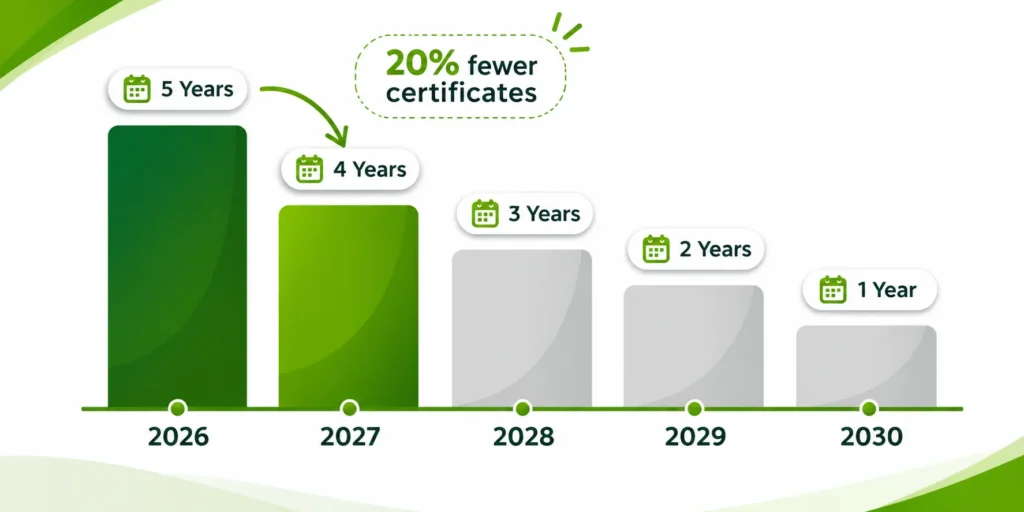
The solar rebate is not a cash payment. It is a discount funded by small-scale technology certificates (STCs), which your installer claims and takes off your quote. The number of certificates comes down to your system size in kilowatts, your postcode’s zone rating, and the deeming period.
The deeming period is the part that changes. It is the number of years of future generation the government counts upfront, and it shrinks by one year every January until the scheme ends in 2030. In 2026 it is five years. From 1 January 2027 it falls to four. Same roof, same system, roughly 20% fewer certificates.
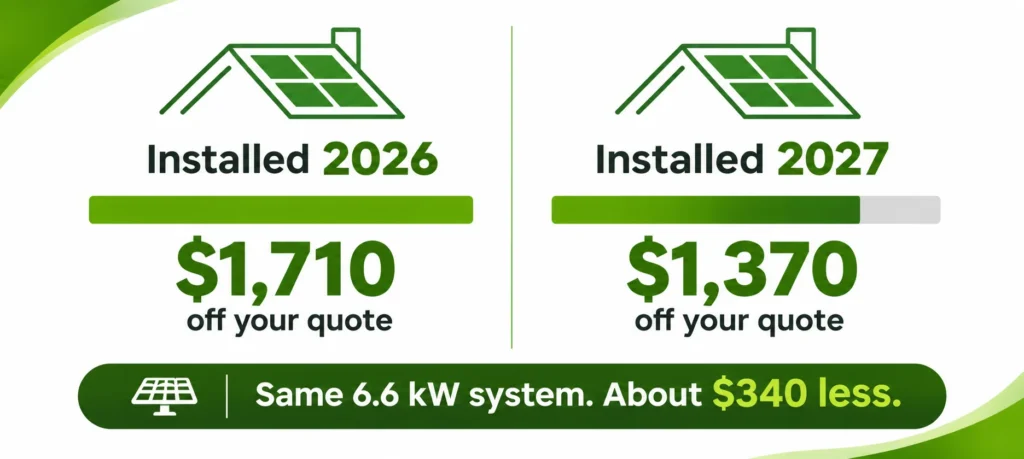
On a 6.6kW system on a Sydney roof (a high-output solar zone), at an STC value of around $38, that is about 45 certificates (roughly $1,710 off) in 2026, against about 36 certificates (roughly $1,370 off) from 2027, a difference of around $340. Bigger systems lose more, with a 10kW array dropping closer to $530. You can browse options on our solar panels range, and our NSW solar rebates guide explains how the panel discount is worked out.
Will the battery rebate drop in 2027 too?
It drops twice. The federal battery rebate, officially the Cheaper Home Batteries Program, runs through the same STC system. Every kilowatt-hour of usable capacity earns certificates set by an STC factor, and since the May changes that factor steps down every six months: 6.8 per kWh now (around $258 per kWh), 5.7 from 1 January 2027 (around $217 per kWh), and 5.2 from 1 July 2027 (around $198 per kWh), with further cuts to 2030.
The discount is also paid in bands, not evenly across the whole battery. The first 14 kWh earns the full factor, the next slice to 28 kWh earns 60%, capacity to 50 kWh earns 15%, and anything above earns nothing. A bigger battery still earns more overall, just less for each extra kilowatt-hour.
What the January step-down costs on popular batteries
Here is the first 2027 cut on batteries we install across Sydney, at an STC price of around $38:
| Battery | Usable size | Now (Till 31 Dec 2026) | From 1 Jan 2027 | You lose by waiting |
|---|---|---|---|---|
| Tesla Powerwall 3 | 13.5 kWh | ~$3,490 | ~$2,920 | ~$570 |
| Tesla Powerwall 3 (×2) | 27 kWh | ~$5,630 | ~$4,720 | ~$910 |
| Sigenergy SigenStor | 16 kWh | ~$3,930 | ~$3,290 | ~$640 |
| Sigenergy SigenStor | 24 kWh | ~$5,170 | ~$4,330 | ~$840 |
| Sungrow (modular) | 12.8 kWh | ~$3,310 | ~$2,770 | ~$540 |
| AlphaESS (modular) | 10 kWh | ~$2,580 | ~$2,170 | ~$410 |
Estimates only, rounded. Based on an STC value of around $38, factors of 6.8 (now) and 5.7 (from January), and the capacity taper above. Your figure varies with the certificate price on the day and your battery’s usable capacity. The rate then drops again on 1 July 2027.
For current pricing see our NSW battery package prices or our 10 kWh battery prices for Sydney.
Does the contract date or the install date lock in my rebate?
The installation date, and nothing else. Not the day you sign, not the day you pay a deposit, not the day the panels land on your driveway. Your rebate is set by the date the system is installed and certified, when the certificate of electrical compliance is issued. A system commissioned on 31 December claims the current rate, while the same system switched on a day later claims the lower 2027 rate. A contract signed in November means nothing if the install slips past New Year, which is how households lose the higher rebate every summer. Ask for a commissioning date in writing and book early. Our guide on questions to ask your installer before you sign is worth a read first.
Don’t forget the NSW top-up: the VPP incentive
The federal rebate is not the only incentive available in New South Wales. On top of it, NSW pays a separate amount under the Peak Demand Reduction Scheme for connecting an eligible battery to an approved Virtual Power Plant, worth up to around $1,500 depending on battery size and provider, and paid on top of the federal discount rather than instead of it. That lets a Sydney household stack three incentives on one install: the federal panel discount, the federal battery discount, and the NSW VPP incentive. Your battery needs to be VPP-capable and signed up with an approved provider (most current models are), you can only claim it once per property, and the old standalone NSW battery install rebate has been retired, so disregard any quote still listing it. Our Virtual Power Plant page explains how a VPP works, and the NSW Home Energy Saver interest-free loan can help spread the upfront cost.
Who is eligible, and can I add a battery to existing solar?
The federal battery rebate is open to all eligible households with no income test, for batteries between 5 kWh and 100 kWh, installed by an accredited installer. You do not need brand-new panels to qualify. In most cases you can add an eligible battery to an existing solar system and still claim, provided the battery, your existing connection, and the installation meet the program’s rules. If you are still weighing it up, our piece on whether a solar battery is worth it lays out the case.
So is it worth rushing?
It depends on your situation, and we would rather give you the honest answer than a countdown clock. If a system was already planned for early next year, moving it forward a few weeks is worth a few hundred dollars on panels and closer to a thousand on a decent battery. If you are not ready, forcing it is the wrong call, because a system sized wrong for your household will cost you more over ten years than the rebate difference ever saved. The rebate is not going away, it is stepping down on a schedule you can plan around. Get a no-obligation quote from our Sydney team and we will show you your current rebate figure on paper, including whether a pre-January install is realistic for your home.
FAQs
How much will the solar panel rebate drop in 2027?
The deeming period falls from five years to four, cutting your certificate count by about 20%. On a 6.6kW Sydney system that is roughly $340 less off your quote, and more on larger systems.
How much will the battery rebate drop in January 2027?
The STC factor falls from 6.8 to 5.7 per kWh on 1 January, then to 5.2 on 1 July. In dollars that is roughly $410 less on a 10 kWh battery and around $570 less on a 13.5 kWh battery from January.
Does the contract date or the installation date set my rebate?
The installation and certification date. Signing a contract in 2026 does not protect you if the system is commissioned in 2027.
Can I claim the NSW battery rebate and the federal rebate together?
Yes. The NSW VPP incentive under the Peak Demand Reduction Scheme stacks with the federal Cheaper Home Batteries rebate on a new install. What you cannot do is combine the federal discount with the retired NSW installation rebate, or claim the NSW VPP incentive twice at one property.
Is the Cheaper Home Batteries Program means tested?
No. It is open to all eligible Australian households regardless of income, for batteries from 5 kWh to 100 kWh.
Can I add a battery to my existing solar system and still get the rebate?
In most cases, yes, as long as the battery, your existing connection, and the installation meet the program’s requirements. A quick assessment confirms your eligibility.