



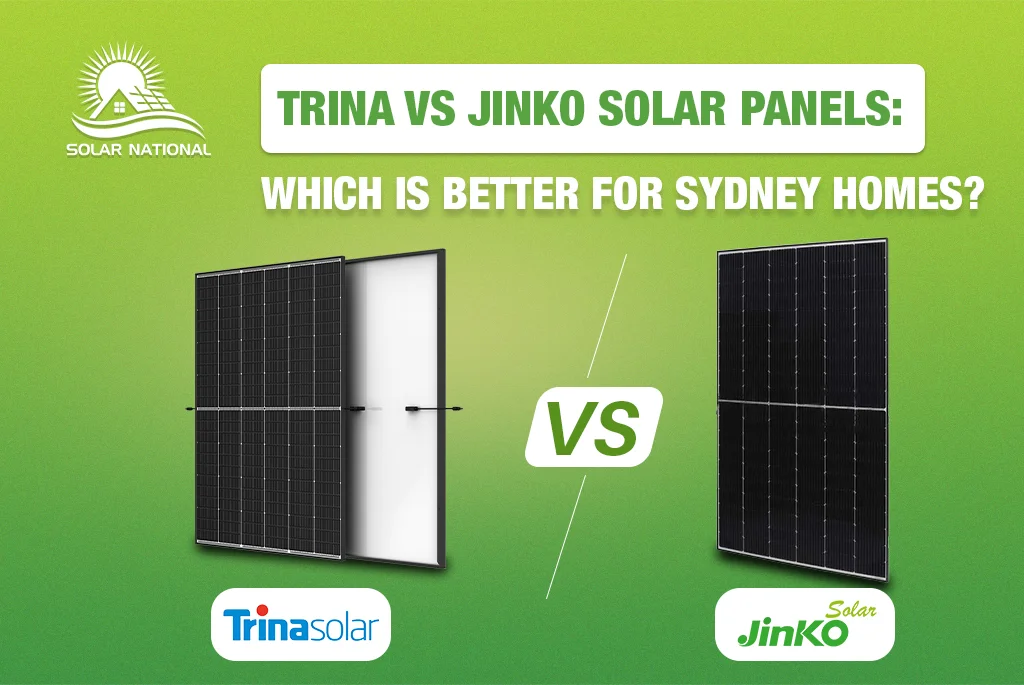
Trina and Jinko turn up more Australian solar quotes than almost any other brand, and there is a good chance both names are sitting in front of you right now. They are the two highest-volume panel makers in the world, both are Bloomberg Tier 1, and both have moved their residential ranges to modern N-type TOPCon cells. Once you line up the datasheets, the gap between them is smaller than either brochure would have you believe.
That is actually the useful starting point. When two panels are this close on paper, the decision stops being about the badge and starts being about your roof, your budget and who is around to answer the phone if something goes wrong in ten years. Here is how Trina’s Vertex S+ and Jinko’s Tiger Neo compare for a Sydney home.
Both use N-type TOPCon technology, which replaced the older P-type PERC cells that were standard until a few years back. N-type panels degrade more slowly, shrug off first-year light-induced losses, and hold output better in heat. If you want the background on why that shift matters, our piece on N-type vs P-type solar panels covers it without the jargon.
So neither brand is a “bad” choice. The differences are in the details below, and they are genuine, just smaller than the marketing suggests.
Head to head
| Trina Vertex S+ | Jinko Tiger Neo | |
| Cell technology | N-type i-TOPCon | N-type TOPCon |
| Peak module efficiency | up to ~23.8% | up to ~23% (higher on newer 3.0 models) |
| Temperature coefficient | -0.29%/°C | ~-0.29%/°C (down to -0.26%/°C on 3.0) |
| Product warranty | up to 25 years (varies by model code) | up to 25 years (varies by model code) |
| Performance warranty | 30 years, 0.4%/year after year one | 30 years, ~87.4% at year 30 |
| Panel weight | ~21 kg (light for its size) | ~24 kg |
| Australian support | Sydney office, wide distribution | Strong local presence, large service network |
Two things to read carefully in that table. First, the warranty on both brands changes with the exact model code, so a Vertex S+ or a Tiger Neo is not automatically a 25-year-product panel. Ask for the datasheet of the wattage being quoted, not the range brochure. Second, the efficiency figures are close enough that on a normal Sydney roof you will not notice the difference in your bill. It only starts to matter when roof space is tight.
Trina Vertex S+: the value pick most Sydney roofs already wear
The Vertex S+ is the most commonly installed residential panel in Australia, and that is not an accident. It pairs N-type i-TOPCon cells with the lowest credible per-watt price of any Tier 1 brand, which is why so many installers default to it. Efficiency runs up to around 23.8% on the stronger models, the temperature coefficient sits at -0.29%/°C, and the dual-glass build weighs only about 21kg, which makes it easier to handle on older Sydney tile roofs and terrace rooftops with awkward access.
Trina also runs an Australian office out of Sydney, so warranty claims are handled locally rather than through an overseas chain. The main thing to watch is the model code: the cheapest Vertex variants can carry a shorter product warranty than the headline 25 years, so confirm which one you are getting. You can see the Trina range we install for current models and finishes.
Jinko Tiger Neo: the ubiquitous all-rounder
Jinko’s Tiger Neo is the other panel you see on almost every second Sydney roof. It uses N-type TOPCon cells, reaches efficiency around 23% (higher on the newer Tiger Neo 3.0 platform), and the current 3.0 modules push the temperature coefficient down toward -0.26%/°C, which is genuinely strong for hot-weather output. The dual-glass construction and salt-mist resistance make it a sensible pick for coastal suburbs from the Northern Beaches down to the Sutherland Shire.
Jinko’s other advantage is scale. It is one of the largest manufacturers on the planet with a deep Australian service network, so parts and support are rarely a problem. As with Trina, the product warranty depends on the model code, so read the datasheet rather than assuming. There is more detail in our full Jinko solar panels review.
What actually decides it for a Sydney home
Because the panels are so close, the tie-breakers are practical rather than technical.
Heat. Both handle Sydney summers well. Jinko’s Tiger Neo 3.0 has a slight edge on paper with its lower temperature coefficient, which shows up most on unshaded western-facing roofs in Penrith, Blacktown and the west where roof surfaces routinely pass 60°C in January. On a typical coastal or shaded roof, you would struggle to measure the difference. Our guide to how efficiency ratings translate to real output explains why lab figures and rooftop figures diverge.
Roof space. If you can only fit ten or twelve panels, squeeze the most out of each one. Trina’s higher-efficiency Vertex S+ models give a small advantage here, which matters on compact Inner West and Eastern Suburbs roofs. Our explainer on sizing a system for your home shows how efficiency and panel count feed into a 6.6kW or 10kW build.
Warranty. This is where the model code does the talking, not the brand. Both offer 30-year performance cover and up to 25-year product cover on their better variants. Do not compare a premium Jinko against a budget Trina and call it a brand win. Read how these promises are structured in our homeowner’s guide to solar panel warranties.
Price. Trina usually comes in slightly cheaper per watt, which is a large part of its popularity. Jinko is rarely far behind. The federal STC rebate reduces the upfront cost of both and steps down each year, so timing affects your incentive. See our breakdown of NSW solar rebates and the wider view on how panel costs vary across brands.
So, which one?
If you want the honest answer: for most Sydney homes, either panel will serve you well for 25 years, and the install quality will affect your outcome more than the choice between these two brands. A mismatched inverter or a rushed job undoes the benefit of a good panel, which is the theme running through our list of mistakes to avoid when buying solar.
That said, a rough steer:
- Tight budget, standard metro roof, want the most popular and lightest panel: Trina Vertex S+.
- Coastal roof, or you want the slight heat-performance edge and the largest support network: Jinko Tiger Neo (3.0).
At Solar National, we install both across Sydney and the surrounding suburbs, and we spec the panel to your roof, shading and budget rather than to whatever is cheapest to stock. If you would like a straight recommendation for your own home, request a quote and we will put the exact model codes and warranty terms in writing.
Frequently asked questions
Are Trina and Jinko panels both Tier 1?
Yes. Both appear on the Bloomberg Tier 1 list, which measures manufacturer bankability rather than panel quality. Both are also on the Clean Energy Council approved list, so systems using them qualify for the STC rebate.
Which handles Sydney heat better, Trina or Jinko?
They are very close, both around -0.29%/°C. Jinko’s newer Tiger Neo 3.0 improves toward -0.26%/°C, giving it a slight edge on hot, unshaded western-Sydney roofs. On coastal or shaded roofs the difference is negligible.
Is Trina cheaper than Jinko?
Trina’s Vertex S+ usually carries the lowest per-watt price of any Tier 1 brand, which is a big reason it is the most installed residential panel in Australia. Jinko is typically only slightly more expensive, so real quotes can land either way.
Does the brand or the warranty model code matter more?
The model code. Both brands sell budget and premium variants with different product warranties (up to 25 years on the better models, shorter on entry-level codes). Always compare the specific datasheet for the panel being quoted, not the brand’s headline range.
Which is better for a coastal Sydney home?
Both are dual-glass and salt-mist certified. Jinko’s wide service network and Tiger Neo salt resistance make it a common coastal choice, though Trina’s dual-glass models are also suitable when installed with the correct clearances and tilt.