


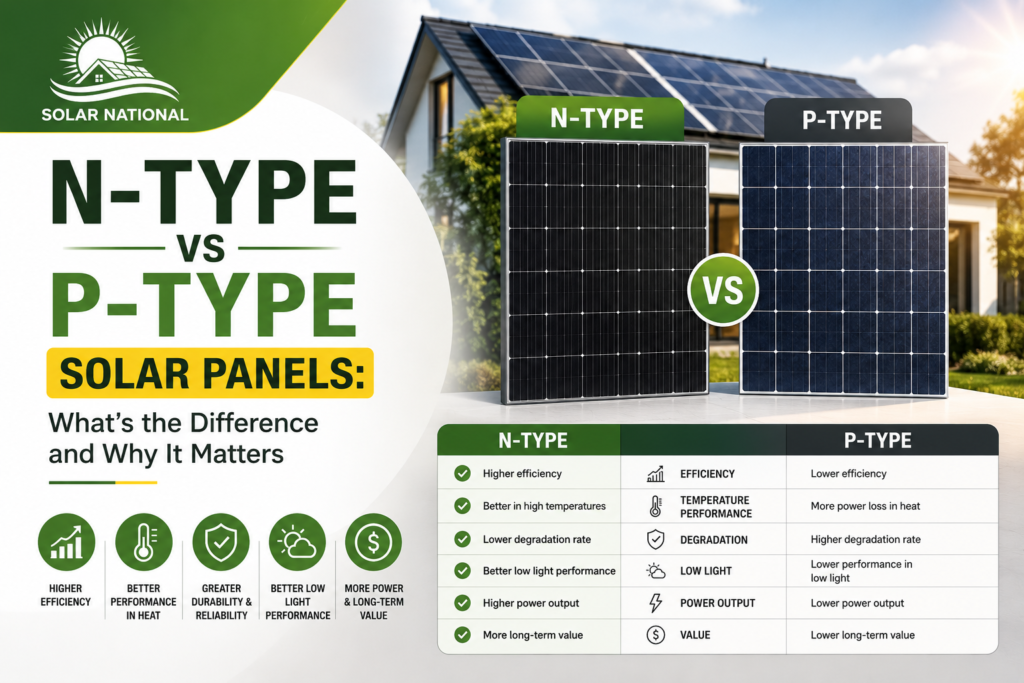
If you have been comparing solar quotes, you have probably run into the terms N-type and P-type, often buried in a spec sheet next to words like TOPCon, PERC or HJT. Most homeowners skim past them, assuming it is technical jargon that does not affect the decision. In reality, this single distinction shapes how much power your panels produce, how well they cope with Australian heat, and how much energy they will still be generating in 25 years.
The good news is that you do not need a physics degree to understand it. This guide explains what N-type and P-type actually mean, how they differ in the ways that matter, and why the answer increasingly points in one direction for Australian homes.
The basics: what N-type and P-type mean
Every silicon solar cell starts as a wafer of pure silicon, which on its own does not generate much electricity. To make it work, manufacturers add tiny amounts of other elements in a process called doping. The type of element used is what gives a cell its name.
P-type cells are doped mainly with boron, which creates a positive charge characteristic. N-type cells are doped with phosphorus, which adds free electrons and creates a negative charge characteristic. That might sound like a minor chemistry difference, but it has real consequences. Phosphorus is more stable than boron when exposed to oxygen, and the extra free electrons help the cell convert sunlight more efficiently. Those two facts sit behind almost every performance difference between the two types.
P-type panels: the established standard
For more than a decade, P-type panels, built on PERC technology, were the backbone of the global solar industry. They became popular because they offered a sensible balance of decent efficiency and low manufacturing cost, which made them ideal for mass production and affordable rooftop solar.
P-type panels are proven, reliable and still perfectly capable. Modern P-type modules reach efficiencies of around 21 to 22 per cent, which is more than enough to deliver strong savings. Their main weakness comes from boron doping. When boron-based cells are first exposed to sunlight, they suffer a small permanent drop in output known as light-induced degradation, or LID, typically costing a few per cent of their initial performance. They also tend to degrade slightly faster over their lifetime.
N-type panels: the new mainstream
N-type panels, most commonly built on TOPCon technology, with premium HJT panels at the top end, are the technology that has now taken over the market. By using phosphorus instead of boron, they sidestep the LID problem almost entirely and deliver higher efficiency from the same roof space.
Commercial N-type panels reach efficiencies of roughly 22.5 to 25 per cent, noticeably ahead of P-type. They also degrade more slowly, hold up better in heat, and carry longer warranties as a result. A few years ago this performance came at a steep premium. Today the price gap has narrowed dramatically, which is exactly why the industry has shifted. You can see the current range of solar panels and the brands leading this transition, with names like Jinko, Trina and LONGi all offering strong N-type lines.
The differences that actually matter
Rather than getting lost in cell architecture, it helps to focus on the four differences that affect your bills and your return on investment.
Efficiency. N-type panels convert more sunlight into electricity, typically a percentage point or two ahead of P-type. On a space-limited roof, that can mean fitting the system you need into fewer panels, or simply generating more from the same area.
Degradation and lifespan. This is where the N-type pulls clearly ahead. Because they avoid boron-oxygen LID, N-type panels lose less output in their first year and degrade more slowly thereafter, at roughly 0.3 to 0.5 per cent a year compared with around 0.6 to 0.8 per cent for P-type. Over 25 years, a typical N-type panel retains around 90 per cent of its output, while P-type retains closer to 85 per cent. That gap adds up to several per cent more energy across the life of the system.
Heat performance. This matters enormously in Australia. Solar panels lose efficiency as they heat up, and the rate at which they do so is called the temperature coefficient. N-type panels have a better temperature coefficient, meaning they hold onto more of their rated output on a scorching summer day. On a 40-degree Sydney rooftop, where panel temperatures climb far higher than the air temperature, that advantage translates directly into more power when you are running the air conditioning the hardest.
Cost. N-type used to command a hefty premium, but in 2026 that gap has shrunk to around 10 to 15 per cent at most, and often less. Given the gains in efficiency, longevity and heat tolerance, the modest extra cost is increasingly easy to justify, and for many systems the lifetime energy advantage more than pays it back.
Why this matters for Australian homes
Australia’s climate makes the N-type advantages especially relevant. Our long, hot summers are precisely the conditions where P-type panels lose the most output and N-type panels pull ahead. A panel that handles heat better and degrades more slowly will quietly generate more electricity every year it sits on your roof, and over a 25 to 30 year lifespan those small annual differences compound into a meaningful amount of money.
There is also the matter of predictability. Because N-type panels degrade in a slower, more consistent way, their long-term output is easier to forecast, which makes the financial case for solar more reliable. When you are sizing a system around your future energy needs, that consistency is genuinely useful. If you are still working out how big your system should be, our guide on what size solar system you need is a good companion to this one.
So which should you choose?
For most new installations in 2026, N-type is the sensible default. It offers higher efficiency, longer life, better heat tolerance and a now-modest price premium, which is why it has become the mainstream choice across the industry. If your roof space is limited, your area runs hot, or you simply want the best long-term return, N-type is the stronger option.
That said, P-type is not a bad choice, and it has not disappeared. If budget is the overriding priority and you have plenty of roof space, a quality P-type system from a reputable brand will still deliver excellent savings for decades. The key, as always, is the overall package: the brand, the warranty, the inverter it is paired with, and the quality of the installation all matter as much as the cell type. A great N-type panel installed poorly will underperform a well installed P-type system.
The market has already made its choice
It is worth knowing how quickly this shift has happened. Just a few years ago, P-type PERC made up around three-quarters of the global market. N-type TOPCon has since become the dominant technology, accounting for the majority of cells produced worldwide, with its share still climbing toward the end of the decade. In practice, this means most quality panels you are quoted today will already be N-type, and the question is increasingly about which N-type panel rather than whether to choose one.
Pairing the right panels with a quality solar inverter, and a battery if storage is part of your plan, is what turns good hardware into a system that performs for decades. As a Sydney-based installer, Solar National can talk you through the panel options that suit your roof, your budget and the local climate, and design a residential solar system around your actual energy use.
If you want a clear, no-pressure recommendation on the right panels for your home, request a free quote and we will walk you through the options.
Frequently Asked Questions
1. What is the main difference between N-type and P-type solar panels?
The difference comes down to how the silicon is doped. P-type cells use boron, while N-type cells use phosphorus. Phosphorus is more stable and adds free electrons, which gives N-type panels higher efficiency, slower degradation and better heat performance than traditional P-type panels.
2. Are N-type solar panels worth the extra cost?
In most cases, yes. The price premium for N-type has narrowed to around 10 to 15 per cent or less in 2026, while the gains in efficiency, lifespan and heat tolerance mean the lifetime energy advantage often outweighs the modest extra cost, especially in a hot climate like Australia’s.
3. Which type is better in Australia’s hot climate?
N-type panels generally perform better in heat. They have a superior temperature coefficient, meaning they lose less output as panel temperatures rise on hot summer days. On a scorching Australian rooftop, that translates into more power exactly when you need it most.
4. Do N-type panels last longer than P-type?
N-type panels degrade more slowly, at roughly 0.3 to 0.5 per cent per year versus around 0.6 to 0.8 per cent for P-type, and they avoid the light-induced degradation that affects boron-based cells. After 25 years, N-type panels typically retain around 90 per cent of their output compared with closer to 85 per cent for P-type.
5. How do I know whether I’m being quoted N-type or P-type?
Check the panel’s spec sheet or ask your installer directly. Terms like TOPCon and HJT indicate N-type, while PERC usually indicates P-type. A reputable installer will happily tell you which technology a quoted panel uses and explain why they have recommended it.