



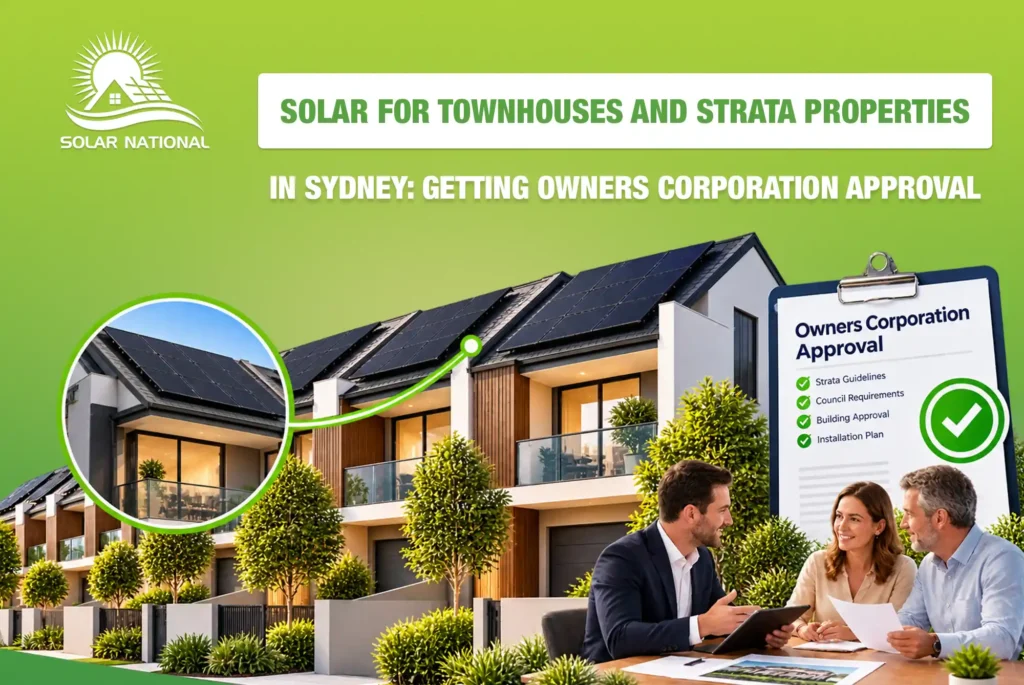
Owning a townhouse or strata unit no longer means paying full price for power while the freestanding homes down the street run on sunshine. Strata solar in Sydney has become far easier to approve under NSW law, yet many owners still stall at the same hurdle: getting owners corporation approval. This guide explains which vote you need, what your committee will ask, and how to put forward a proposal that passes the first time.
Whether you own a three-lot townhouse complex in Castle Hill or a unit in a 40-lot block in Chatswood, the legal framework is the same. The difference is in the detail, and the detail is where most applications succeed or fail.
Can You Install Solar on a Townhouse or Strata Property in Sydney?
In most cases, yes. The first question is not technical. It is about how your property is titled.
- Torrens title townhouses: If your townhouse sits on its own Torrens title lot, you generally own the roof above you and do not need owners corporation consent. Check for any easements or a community association, then the process is much like a freestanding home.
- Strata title townhouses and units: The roof is usually common property, owned collectively by the owners corporation. Any panels, cabling or roof penetrations on common property need approval.
- Community title: The rules come from the scheme’s management statement, so read it before you collect quotes.
A practical tip from the field: ask your strata manager for the registered strata plan. Some townhouse schemes draw lot boundaries to include the roof space, which changes the approval you need. Ten minutes with the plan can save weeks of the wrong paperwork.
How NSW Strata Law Changed for Solar Panels
For years, solar on a common property roof needed a special resolution, meaning at least 75 per cent of votes in favour. A handful of opposed owners could block a project indefinitely.
That changed on 24 February 2021, when section 132B was added to the Strata Schemes Management Act 2015. Solar panels now count as sustainability infrastructure, and a sustainability infrastructure resolution only needs to clear a threshold of roughly half the votes cast, rather than three in four. NCAT has stated plainly that solar panels are sustainability infrastructure, so there is little room for argument on that point.
Further reforms from July 2025 strengthened the owner’s position again:
- An owners corporation can no longer refuse sustainability infrastructure purely because of how it looks, unless the building is heritage listed or sits in a heritage conservation area.
- Owners corporations are expected to consider the scheme’s sustainability as a standing item at each annual general meeting.
For townhouse owners, this means a single objecting neighbour can no longer veto your solar plans on taste alone.
Three Ways to Go Solar in a Strata Scheme
1. A dedicated system for one lot. Panels go on the section of roof above your lot and connect to your own meter. You need a sustainability infrastructure resolution plus a common property rights by-law that gives you use of that roof area and sets out your responsibilities. This is the most common route for townhouses.
2. A common property system. The owners corporation installs panels to run shared loads such as lifts, car park lighting, pool pumps and ventilation. Lower common area bills reduce levies for every owner, which usually makes this the easiest proposal to pass.
3. Shared solar across lots. Larger apartment buildings can split generation between participating units through an embedded network or allocation technology. It involves metering and retailer arrangements, so it suits bigger schemes with generous roof space.
Step-by-Step: Getting Owners Corporation Approval
- Speak to the strata committee early. An informal conversation before any formal motion surfaces the real objections, which are usually roof leaks, appearance and who pays.
- Get a site inspection and system design. A proper assessment confirms roof structure, usable area, shading and switchboard capacity. A typical 6.6kW system needs around 30m² of usable roof, as covered in our guide to solar panel size, dimensions and weight. Many Sydney townhouse roofs comfortably fit 5kW to 6.6kW.
- Prepare the motion and draft by-law. Your strata manager or a strata lawyer can draft both. The motion should be clearly labelled as a sustainability infrastructure resolution.
- Answer the section 132B questions in writing. Before approving, the owners corporation must consider the cost of the infrastructure and works, including ongoing maintenance, who will own, install and maintain it, and how it will be funded. Put those answers in your motion pack so nobody has to guess.
- Get it on the agenda. Add it to the next AGM or ask the strata manager to call an extraordinary general meeting. Allow for the required notice period.
- Vote, then register the by-law. A new by-law has no effect until it is lodged with NSW Land Registry Services, which should be done within six months of the meeting.
- Install and connect. An accredited installer completes the work, issues the electrical compliance certificate and arranges network approval with Ausgrid or Endeavour Energy.
What a Strong Solar By-Law Should Cover
Committees approve proposals that protect the building. A well-drafted by-law sets out the exact roof area used, installation standards for sealing roof penetrations, and who pays for maintenance and repairs. It should also cover insurance, an indemnity for the owners corporation, access if the roof needs repairs, and removal and roof restoration at the end of the system’s life. When those points are covered up front, most objections disappear.
Sydney-Specific Factors Your Committee Will Ask About
Roof type. Terracotta tiles are common on townhouses across the Hills District and Sutherland Shire, while newer estates in Marsden Park lean towards Colorbond. Older unit blocks often have flat concrete roofs with a waterproof membrane, which call for tilt frames or ballasted mounting to avoid unnecessary penetrations.
Shading. In high-density centres such as Chatswood, Parramatta and Rhodes, neighbouring towers can shade a roof for part of the day. A shade analysis, and microinverters or optimisers where needed, protects output.
Coastal exposure. Buildings in Bondi, Coogee, Cronulla and the Northern Beaches face salt-laden air. Corrosion-resistant panels and stainless fixings matter, which is why our solar panel installation in the Eastern Suburbs uses hardware suited to coastal conditions.
Heritage. Paddington, Balmain and parts of the Inner West include heritage conservation areas. Rooftop solar on most Sydney homes does not need development approval, but heritage controls can change that, and the July 2025 protection against aesthetic refusals does not apply to heritage buildings.
Rebates and Savings for Strata Owners
Strata owners can access the same incentives as any NSW household. Small-scale technology certificates reduce the upfront price of your panels, and the federal Cheaper Home Batteries Program has taken roughly 30 per cent off eligible batteries since 1 July 2025. That discount steps down over time, so timing matters. See our guides to NSW solar rebates and the federal solar battery rebate for current figures.
If you plan to add storage, include the battery location in your by-law, particularly if it will sit in a garage or on common property. A compact option such as the Neovolt battery suits townhouse garages well. Owners thinking about an electric vehicle can bundle an EV charger into the same sustainability motion.
What If the Owners Corporation Says No?
Ask for the reasons in writing first. Many refusals are about incomplete information, and a revised proposal with a stronger by-law often passes at the next meeting.
If you believe consent was unreasonably refused, the NSW Civil and Administrative Tribunal can order that a by-law be made. In Laws v The Owners – Strata Plan 97230 [2022] NSWCATCD 131, an Ettalong owner whose solar by-law was voted down obtained exactly that order. Seek strata legal advice before taking this step.
How Solar National Helps Sydney Strata Owners
Solar National is an Australian owned company with clean energy accredited installers and SAA approved installations, working from Chatswood and Seven Hills across Sydney. We design premium Tier 1 solar panel systems for townhouses, unit blocks and whole strata schemes.
For strata clients, we inspect the roof, provide a layout drawing and quote, and supply the technical answers your owners corporation needs under section 132B. That gives your committee everything it needs to vote with confidence.
Ready to take your strata solar proposal to the next meeting? Call 1300 179 949 or request your free strata solar assessment and our team will help you build a proposal your owners corporation can say yes to.
Frequently Asked Questions
Do I need strata approval to put solar panels on my townhouse in Sydney?
If your townhouse is strata titled and the roof is common property, yes. You need a sustainability infrastructure resolution and usually a by-law. Torrens title townhouses generally do not need owners corporation consent.
What vote is needed to approve solar panels in an NSW strata scheme?
Solar is approved through a sustainability infrastructure resolution under section 132B of the Strata Schemes Management Act 2015. It needs roughly half the votes cast rather than the 75 per cent required for a standard special resolution.
Can my owners corporation reject solar panels because they look unattractive?
Not on appearance alone. Since July 2025, NSW owners corporations cannot refuse sustainability infrastructure purely on aesthetic grounds, unless the building is heritage listed or in a heritage conservation area.
Who pays for solar panel maintenance on a strata roof in Sydney?
For a system serving one lot, the by-law normally makes that owner responsible for maintenance, repairs, insurance and eventual removal. For a common property system, the owners corporation pays through levies.
Can strata owners in Sydney claim the federal solar battery rebate?
Yes. The Cheaper Home Batteries Program applies to eligible batteries in strata homes and townhouses, provided the battery connects to solar and is installed by an accredited installer. Include the battery’s location in your by-law.
How long does strata solar approval take in Sydney?
Most schemes take four to twelve weeks, depending on meeting notice periods and whether you wait for the AGM or call an extraordinary general meeting. By-law registration follows the vote.
Can a Sydney apartment building share one solar system between units?
Yes. Larger buildings can share generation through an embedded network or allocation technology, while smaller blocks often start with a common property system that reduces levies for every owner.