



A standard power point trickles about 10 km of range into your car per hour. A proper Level 2 wall charger adds around 40 km per hour, roughly four times faster, so a flat battery is full by morning. That single upgrade is the difference between managing your EV around a slow cable and never thinking about charging at all.
We install EV chargers across Sydney alongside solar and battery systems, so this guide is written from the tools. Below we rank the best home EV chargers in Australia for 2026, call out the best 7kW and best 3-phase options separately, give real installed prices, and flag the drawbacks other guides skip.
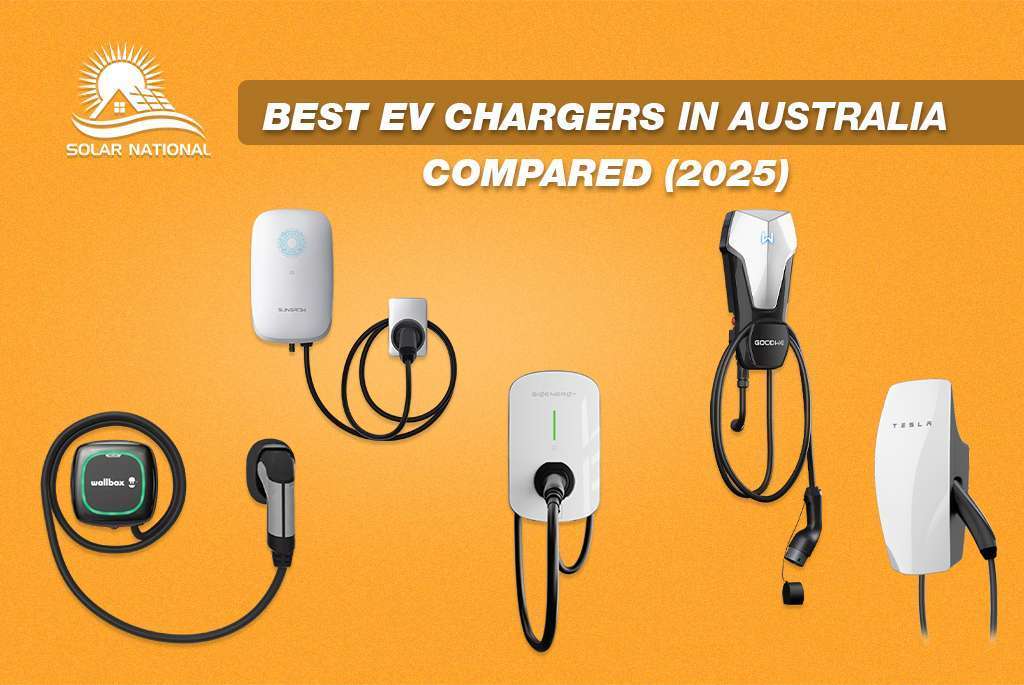
Quick answer: for a solar home, the myenergi Zappi v2 and the Evnex E2 Plus are the two best home EV chargers in Australia right now. For best value without solar, the Ocular IQ or Evnex E2 Flex win. Tesla owners are well served by the Tesla Wall Connector. Full reasoning below.
Best home EV chargers in Australia 2026 at a glance
| Charger | Power | Solar integration | Unit price (approx) | Best for |
|---|---|---|---|---|
| myenergi Zappi v2 | 7kW / 22kW | Best in class | $1,200-$1,545 | Solar households |
| Evnex E2 Plus | 7.4kW | Yes (built in) | ~$1,399 | Solar homes wanting a 4-year warranty |
| Evnex E2 Flex | 7.4kW | Upgradable later | ~$799 | Best value, no solar yet |
| Ocular IQ Home | 7kW / 22kW | Yes | ~$700-$900 | Best value overall |
| Tesla Wall Connector | 7kW / 11kW | Manual (set amps) | ~$800 | Tesla owners |
| Sigenergy AC/DC | 7kW / 22kW / 25kW DC | Yes (with Sigen battery) | from ~$1,200 | Sigenergy battery owners |
| Fronius Wattpilot | 11kW / 22kW | Excellent | ~$1,000 | Fronius inverter owners |
| Wallbox Pulsar Plus | 7.4kW | Limited | ~$900 | Small / urban installs |
Installed cost typically adds $400 to $1,000 to the unit price depending on your switchboard and cable run. Full install pricing is further down.
The best home EV chargers in Australia, reviewed
1. myenergi Zappi v2: best overall for solar homes
The Zappi is the best-selling solar-compatible charger in Australia for a reason. Its three charging modes (Fast, Eco and Eco+) let you draw from the grid, top up from solar, or charge only on pure solar surplus. On a 6kW+ solar system, Eco+ mode during the day effectively makes your daily driving free.
Available in 7kW single-phase and 22kW three-phase, with a smartphone app and an on-unit screen so you can start a session without touching your phone.
The honest caveat: the Zappi was designed for the UK climate and is not rated to operate above 40 degrees. Do not mount it on a north-facing sunny wall in Australia. There have also been scattered reports of overheating at full 22kW load on three-phase during long summer sessions. On single-phase 7kW, which covers most Sydney homes, this is not an issue. Warranty is three years, shorter than Evnex.
2. Evnex E2 Plus / Core: best build quality and warranty
The Evnex E2 range is New Zealand-made and has become the go-to charger for many Australian installers. All models include dynamic load balancing, which automatically slows charging when your home is drawing a lot of power so your switchboard is never overloaded. That is a genuinely useful safety feature on older Sydney homes.
The E2 Plus (around $1,399) has an 8m cable, 4G connectivity for homes with poor Wi-Fi, and solar diversion built in. The E2 Core (around $1,100) is the same charger with a 5m cable on Wi-Fi. Both carry a 4-year warranty, the longest in this guide, and Australian-based support.
3. Evnex E2 Flex: best value if you do not have solar yet
The Flex (around $799) is the same hardware as the Core and Plus with the solar-aware software switched off. If you add solar later, Evnex can turn it on remotely for a one-off fee, no electrician revisit needed. For a household getting an EV now and planning solar down the track, this is the smart-money pick.
4. Ocular IQ Home: best value overall
Australian-certified, weather-rated for outdoor installation, app-controlled and solar-integrated, at a unit price a few hundred dollars below the Zappi. It works with every Type 2 EV sold in Australia and comes in both 7kW single-phase and 22kW three-phase. If you want a reliable, no-fuss solar-aware charger without paying premium money, start here.
5. Tesla Wall Connector: best for Tesla owners
Reliable, well-built, and around $800. It integrates neatly with the Tesla app and adds up to 75 km of range per hour on three-phase. It has no automatic solar-aware mode and no dynamic load balancing, but you can set the charge current manually in the app to roughly match your solar output. Works with non-Tesla EVs via the Type 2 connector.
6. Sigenergy AC/DC charger: best for Sigenergy battery owners
If you already run or are installing a Sigenergy battery, the Sigenergy charger is worth a serious look. It offers solar-surplus charging, a strong protection feature set, and a bidirectional-ready 25kW DC option that pairs with the SigenStor battery. Note that some advanced features, including solar surplus charging, require the Sigen battery system, so it makes most sense as part of a Sigenergy setup rather than a standalone charger.
7. Fronius Wattpilot: best for Fronius inverter owners
Plug-and-play, 11kW or 22kW, with excellent solar integration and smart load balancing. The natural choice if you already have a Fronius inverter and want everything in one ecosystem.
Best 7kW EV charger in Australia
For about 95% of Australian homes, a 7kW single-phase charger is the right choice. It adds roughly 40 km of range per hour and fully charges most EVs overnight from flat, which is all a typical household needs.
Our pick for the best 7kW EV charger is the Evnex E2 Plus for solar homes (built-in solar diversion, dynamic load balancing, 4-year warranty), or the Ocular IQ Home 7kW if value is the priority. The Zappi v2 in 7kW single-phase is equally strong and avoids the overheating concern that only affects the 22kW three-phase version.
A 7kW charger runs on standard single-phase power that almost every Sydney home already has, so no expensive supply upgrade is needed.
Best 3-phase EV charger in Australia (22kW)
You only need a 3-phase EV charger if your property has three-phase supply and you regularly drive very high daily distances, or you want to charge two EVs quickly. Three-phase delivers up to 22kW, roughly tripling charge speed over 7kW single-phase. Most homes do not need it, and if you do not have three-phase supply, adding it is a significant cost.
Our pick for the best 3-phase EV charger is the myenergi Zappi v2 (22kW) for solar homes, with the caveat above about heat: install it in shade, never a north-facing wall. The Ocular IQ Home 22kW and Fronius Wattpilot 22kW are strong alternatives, and the Fronius is the natural fit if you already run a Fronius inverter. For Sigenergy battery homes, the Sigenergy 22kW AC or 25kW DC unit is the integrated option.
Before ordering any 22kW charger, confirm your switchboard actually has three-phase supply. Our electricians check this at the site inspection.
How to choose the right EV charger
| Your situation | Recommended charger |
|---|---|
| Solar home, want to maximise free charging | myenergi Zappi v2 or Evnex E2 Plus |
| Best value, reliable daily driver | Ocular IQ Home 7kW |
| EV now, solar planned later | Evnex E2 Flex |
| Tesla owner | Tesla Wall Connector |
| Sigenergy battery owner | Sigenergy AC/DC charger |
| Fronius inverter already installed | Fronius Wattpilot |
| Small garage or urban carpark | Wallbox Pulsar Plus |
| Three-phase supply, very high daily km | Zappi v2 22kW (install in shade) |
What to check before installing an EV charger
Switchboard capacity. Your board needs a spare slot and enough headroom for a dedicated Level 2 circuit. Older Sydney homes sometimes need a switchboard upgrade, the most common unexpected cost.
Single-phase vs three-phase. Most homes are single-phase and suit a 7kW charger. Only go three-phase if you have the supply and genuinely need 22kW.
EV compatibility. Every EV sold in Australia uses a Type 2 socket, so any quality charger here will fit your car.
Solar integration. If you have rooftop solar, a solar-aware charger diverts surplus generation into your car instead of exporting it for a low feed-in tariff. Pair this with a home battery and you can charge on stored solar after dark too.
Buy through your installer. When the same company supplies and installs the charger, one party is responsible for both the hardware and that it works. Free chargers bundled with a car vary a lot in quality.
How much does EV charger installation cost in Sydney?
Installed cost, hardware plus a licensed electrician, typically lands as follows:
- Basic single-phase (7kW): $1,200 to $1,800
- Three-phase (up to 22kW): $2,000 to $2,800
- Smart solar-integrated install: $2,500 to $3,500+
Prices include the unit, installation, compliance certification and any minor electrical work. The variables that push cost up are switchboard upgrades and long cable runs from the meter board to the garage. We quote these upfront after a site inspection, not on install day. All work is carried out by CEC-accredited installers to AS3000 standards.
EV charger rebates in Australia (2026)
Rebates for home EV chargers change often and vary by state, so treat any figure as a starting point and confirm current eligibility before you buy. Historically NSW has run an EV home charging incentive, and several states offer support tied to smart or solar-integrated chargers installed by a licensed electrician.
For the current state-by-state position, see our guide to EV charger rebates and incentives in Australia. Solar National confirms what you qualify for as part of your quote.
Why install an EV charger at home?
Faster, safer charging. A Level 2 charger is up to 10x faster than a power point and adds load balancing, surge protection and circuit isolation.
Lower running costs. Schedule charging for off-peak hours, or pair with solar to charge for close to nothing. Sydney homes running a solar-aware charger on rooftop solar routinely cut charging costs by more than half.
Property appeal. As EV ownership climbs, a home already wired for charging is one less job for the next buyer.
Our verdict
For most Sydney homes with solar, the myenergi Zappi v2 (7kW, installed in shade) or the Evnex E2 Plus are the best home EV chargers you can buy in 2026, the Evnex edging ahead on warranty and load balancing, the Zappi on solar-mode granularity. Without solar, the Evnex E2 Flex and Ocular IQ deliver almost everything for meaningfully less. Tesla drivers should stick with the Tesla Wall Connector, and Sigenergy or Fronius owners are best staying in their own ecosystem.
Whichever you choose, a properly installed Level 2 charger changes EV ownership from a daily logistics problem into something you never think about. Get a free quote for EV charger installation in Sydney and we will match the right charger to your car, your switchboard and your solar setup.
Frequently asked questions
What is the best home EV charger in Australia in 2026?
For solar homes, the myenergi Zappi v2 and Evnex E2 Plus are the best home EV chargers in Australia. For best value without solar, the Ocular IQ Home and Evnex E2 Flex lead. Tesla owners are best served by the Tesla Wall Connector.
What is the best 7kW EV charger?
The Evnex E2 Plus (solar homes) and Ocular IQ Home 7kW (best value) are our top 7kW picks. A 7kW single-phase charger suits about 95% of Australian homes, adding roughly 40 km of range per hour and fully charging most EVs overnight.
What is the best 3-phase EV charger?
The myenergi Zappi v2 22kW is our pick for the best 3-phase EV charger, installed in shade to avoid heat issues. The Ocular IQ Home 22kW and Fronius Wattpilot 22kW are strong alternatives. You only need three-phase if your property has three-phase supply and you drive very high daily distances.
Do I need a 3-phase EV charger?
Probably not. Most Australian homes are single-phase and a 7kW charger fully charges most EVs overnight. Only choose 22kW three-phase if you already have three-phase supply and regularly drive 400+ km per day, as adding three-phase supply is expensive.
How much does EV charger installation cost in Sydney?
A basic single-phase 7kW install runs $1,200 to $1,800, three-phase up to 22kW runs $2,000 to $2,800, and a smart solar-integrated install runs $2,500 to $3,500+. Switchboard upgrades and long cable runs are the main variables.
Can I charge my EV from solar panels?
Yes. A solar-aware charger such as the Zappi, Evnex E2 Plus or Ocular IQ diverts surplus solar into your car instead of exporting it. On a sunny day with the car parked at home, much of your charging can effectively cost nothing.