


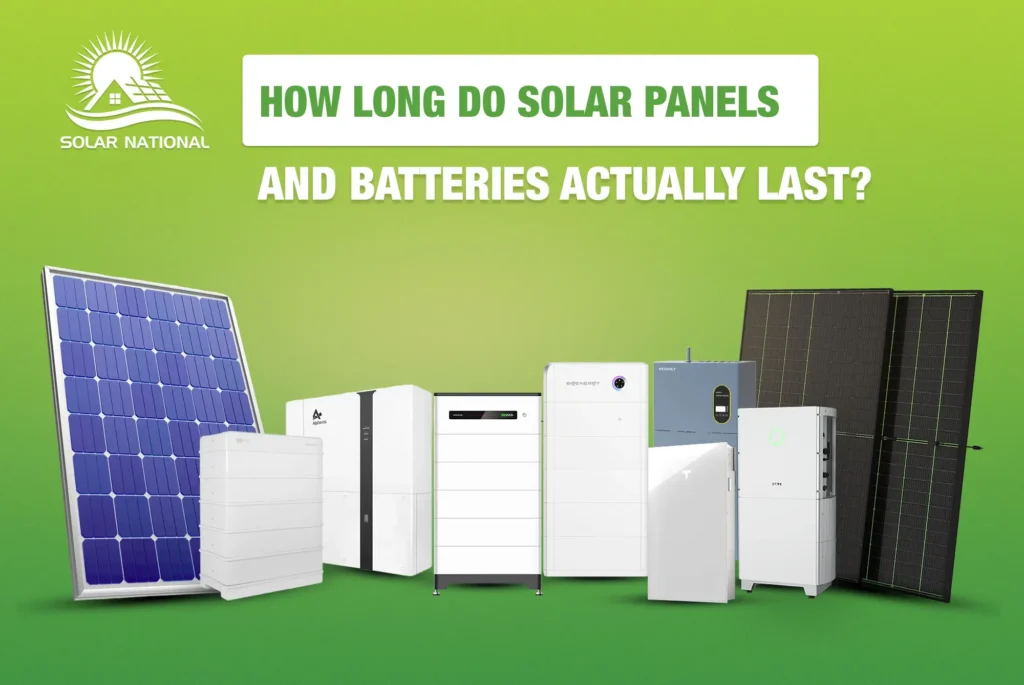
Solar panels typically last 25 to 30 years, while home batteries last around 10 to 15 years. The inverter usually sits in between, at roughly 10 to 15 years. So a solar system is not a single lifespan but a set of parts that age at different rates, which is worth understanding before you buy so you can plan for the long term. This guide explains what to expect from each component, what the warranties actually cover, what shortens their life, and how to get the most years out of your system.
Lifespan at a glance
| Component | Typical lifespan | Usual warranty |
| Solar panels | 25 to 30 years | 25-year performance warranty |
| Home battery | 10 to 15 years | Around 10 years |
| Inverter | 10 to 15 years | 5 to 10 years, often extendable |
How long do solar panels last?
Solar panels are the most durable part of the system, with a working life of 25 to 30 years and often longer. They do not stop suddenly at a set date. Instead they slowly produce a little less each year, a process called degradation, which for quality panels is usually around half a percent a year. That is why most panels come with a performance warranty guaranteeing they will still produce a high share of their original output, commonly around 85 to 90 percent, at the 25-year mark.
The first year sees slightly more settling, after which the decline is gentle and steady. In practice, panels installed today will very likely still be generating useful power well beyond their warranty period, just at a modestly reduced output. To understand what the cover includes, and the difference between the product and performance warranties, see our guide to solar panel warranties.
How long do solar batteries last?
Home batteries last around 10 to 15 years. Unlike panels, a battery’s life is shaped less by age and more by how many charge and discharge cycles it goes through. Every time it fills up and empties counts as roughly one cycle, and a battery cycled once a day will use its cycles faster than one used more gently.
Most modern home batteries use lithium iron phosphate (LFP) chemistry, which is built for a long cycle life, often several thousand cycles, and holds up well to daily use. Depth of discharge also matters: LFP batteries can safely use most of their capacity each cycle, which is part of why they have become the standard for home storage. You can see the solar battery options we install.
What the battery warranty really tells you
Battery warranties are usually around 10 years and are often expressed as a retained capacity, for example guaranteeing the battery will still hold a set percentage of its original capacity at the end of the term. Some warranties also cap the total energy throughput or number of cycles covered. When comparing batteries, that retained-capacity figure tells you more than the headline years, because it describes how much useful life you are actually being promised. A battery does not die at the end of its warranty either; it simply carries less guarantee and will hold a bit less charge.
What about the inverter?
The inverter is usually the first part of the system you will need to replace, typically after 10 to 15 years. Because it works hard whenever the sun is up, converting your panels’ DC output into usable AC power, it runs more hours under load than almost anything else in the system, so it ages faster than the panels. We cover this in detail in our guide to how long a solar inverter lasts, including the warning signs it is on the way out and when a hybrid replacement makes sense.
What affects how long your system lasts?
- Component quality: premium panels, batteries and inverters simply last longer than budget ones, which is where the cheapest quote often costs more over time.
- Heat: electronics age faster when they run hot, so shaded, ventilated placement for the inverter and battery helps, which matters through Australian summers.
- Installation quality: a clean, well-designed install by an accredited installer avoids the faults and water ingress that shorten life.
- Usage patterns: a battery cycled hard every day reaches its cycle limit sooner than one used more gently.
- Maintenance: occasional cleaning and monitoring catches small issues before they become failures.
Signs your system is ageing
A gradual, expected decline in panel output is normal. What is worth acting on is a sudden or steep drop in generation, an inverter throwing frequent faults or going offline, a battery that no longer holds you through the evening the way it used to, or error messages in your monitoring app. Catching these early, rather than waiting for a complete failure, keeps your system generating and often keeps a repair within warranty.
How to make your solar system last longer
- Choose quality components and an accredited installer from the start.
- Keep the inverter and battery in a shaded, well-ventilated spot, out of direct afternoon sun.
- Check your monitoring app regularly so you notice any drop in output early.
- Book an occasional system health check, especially as the system passes the 10-year mark.
- Keep panels reasonably clean so they perform near their rating, and clear any debris or shading that builds up over time.
Does your location affect how long solar lasts?
To an extent, yes. Panels and electronics are built to handle Australian conditions, but sustained high heat speeds up ageing, which is why inverter and battery placement in a shaded, ventilated spot matters more in hot inland areas. Coastal homes have a different consideration, since salt air can affect mounting hardware over time, so quality components and corrosion-resistant fixings are worth specifying near the coast. In both cases the panels themselves are highly durable; it is the surrounding hardware and electronics that benefit most from being installed with the local climate in mind.
What happens at the end of life?
When panels or batteries do reach the end of their useful life, they can be recycled rather than sent to landfill. Australia’s solar recycling capacity has grown as the first big wave of installations ages, and the materials in both panels and batteries, including glass, aluminium and the battery cells, can be recovered. Planning for replacement is straightforward: panels usually keep going well past their warranty, so the more likely early replacements are the inverter and, later, the battery, both of which can be swapped without redoing the whole system.
How panel degradation works in more detail
It helps to understand why panels slowly produce less over time. The materials in a panel are exposed to decades of sun, heat, cold and moisture, and that gradually reduces how efficiently the cells convert light into electricity. Manufacturers measure this as an annual degradation rate, and for quality panels it is usually around half a percent a year after a slightly larger drop in the first year. At that rate, a panel producing its full output today would still be producing the large majority of it in 25 years. Cheaper panels tend to degrade faster, which is one of the hidden costs of buying on price alone, since a panel that fades quickly generates less power, and therefore less saving, across its whole life.
Repair or replace?
When something does go wrong, the decision depends on the component and its age. A panel fault is uncommon and, if it happens within the performance or product warranty, is usually repaired or replaced under that cover. An inverter that fails after a decade is often better replaced than repaired, especially since a newer model is more efficient and a hybrid unit opens the door to adding a battery. A battery nearing the end of its warranty that no longer holds enough charge can be replaced without touching the rest of the system. Because the parts age at different rates, you rarely need to replace everything at once, which spreads the cost out over the system’s life. If you are unsure whether a repair is covered, our guide to the warranty claim process explains how it works.
Frequently asked questions
How long do solar panels last?
Solar panels typically last 25 to 30 years and often longer. They degrade slowly, around half a percent a year, so most come with a 25-year performance warranty guaranteeing a high share of their original output.
How long do solar batteries last?
Home batteries last around 10 to 15 years, shaped by how many charge cycles they go through. Most use LFP chemistry for a long cycle life and carry a warranty of about 10 years.
Which part of a solar system fails first?
Usually the inverter, at roughly 10 to 15 years, because it works whenever the sun is up. Panels are the longest-lasting component.
Do solar panels stop working after 25 years?
No. The 25-year figure is the performance warranty, not an expiry date. Panels usually keep producing useful power well beyond it, just at a slightly reduced output.
Can solar panels and batteries be recycled?
Yes. Both can be recycled, and Australia’s recycling capacity has grown as early installations age. Materials such as glass, aluminium and battery cells can be recovered rather than sent to landfill.
Plan a system built to last
The team at Solar National installs quality panels, batteries and inverters designed for the long run, and can advise on maintenance to get the most from them. Contact us for a free assessment.