


When it comes to solar battery storage, one question comes up again and again: should you go with an AC-coupled or DC-coupled system? The answer depends on your existing setup, your goals, and your budget and getting it right can mean thousands of dollars saved (or lost) over your battery’s lifetime.
In this guide, we break down exactly how each system works, where they differ, and which one makes the most sense for Australian homeowners.
How Solar Energy Flows — A Quick Primer
Before diving into the AC vs DC debate, it helps to understand what these terms mean in practice. Solar panels generate direct current (DC) electricity. Your home appliances, however, run on alternating current (AC). A solar inverter bridges the gap by converting DC into usable AC power.
Where things get interesting is how and when a battery gets charged along that journey and that’s precisely where the AC-coupled vs DC-coupled distinction comes in. If you’re still new to how solar systems are put together, it’s worth reading through how solar panel installation works before diving deeper into battery coupling.
What Is a DC-Coupled Battery System?
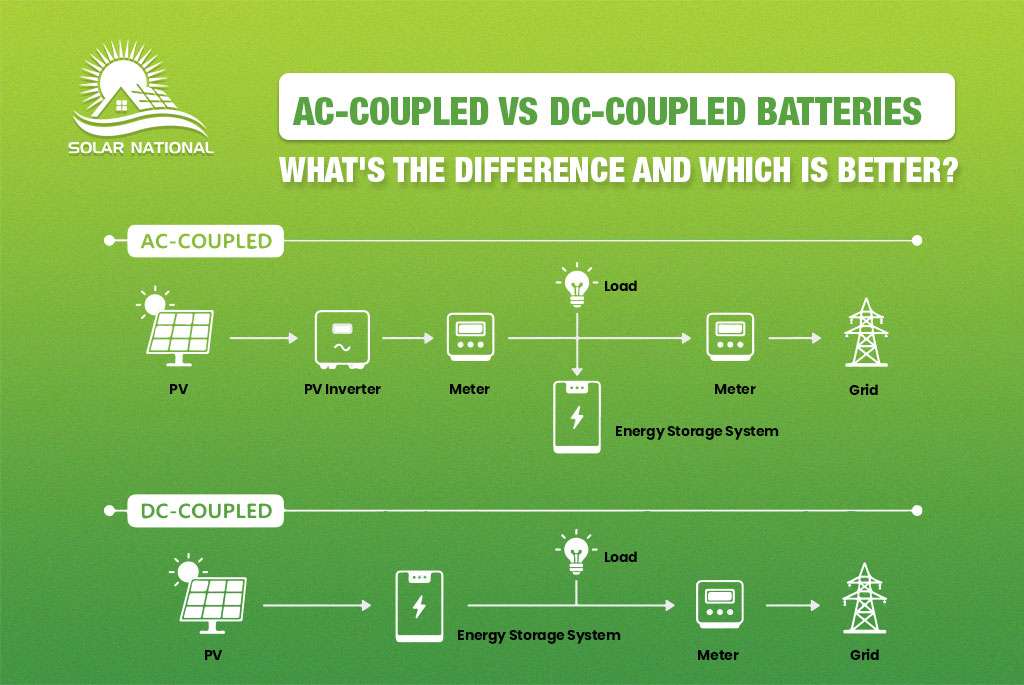
In a DC-coupled battery system, solar energy travels directly from your panels into the battery before it ever gets converted to AC. The DC-to-AC conversion happens only once after the energy exits the battery using a hybrid inverter (also called a multi-mode or all-in-one inverter).
The big advantage? Fewer conversion steps means less energy lost as heat. DC-coupled setups typically achieve 95–98% round-trip efficiency, making them the more efficient option in most scenarios.
DC-coupled systems are ideal for:
- New solar and battery installations designed from scratch
- Properties aiming for off-grid living or heavy energy self-sufficiency
- Homeowners who want to extract maximum performance from their solar battery investment
Popular DC-coupled batteries in Australia include the BYD Solar Battery and the Sungrow Solar Battery, both of which are designed to work seamlessly with compatible hybrid inverters.
What Is an AC-Coupled Battery System?
In an AC-coupled battery system, solar energy is first converted from DC to AC by the solar inverter then a separate battery inverter converts it back to DC to charge the battery. When you draw from the battery later, it gets converted to AC one more time.
Yes — that’s three conversions. Each step loses a small percentage of energy (typically 3–5%), so the round-trip efficiency of an AC-coupled system sits around 89–94%. However, the real-world financial impact of this gap is often smaller than it sounds for a typical household.
AC-coupled systems are ideal for:
- Homes with an existing solar system that want to add battery storage without replacing the inverter
- Properties using popular retrofit batteries like the Tesla Powerwall 3 or Tesla Powerwall 2
- Homeowners who want flexibility in battery brand selection
A good example of a purpose-built AC-coupled product is covered in our detailed GoodWe AC-Coupled Battery guide, which walks through exactly how these systems are installed and configured.
AC vs DC-Coupled: Full Comparison
| Feature | AC-Coupled | DC-Coupled |
| Round-trip efficiency | 89–94% | 95–98% |
| Inverter setup | Solar inverter + battery inverter | Single hybrid inverter |
| Best for | Retrofitting existing solar | New solar + battery installs |
| Battery compatibility | Wide — most brands supported | Limited to hybrid inverter ecosystem |
| Blackout protection | Good (if inverter supports islanding) | Excellent (built into hybrid inverter) |
| Off-grid suitability | Moderate | High |
| Upfront cost | Lower if reusing existing inverter | Higher if replacing existing inverter |
| Expandability | Easy to add more batteries | Limited by hybrid inverter capacity |
| Popular examples | Tesla Powerwall, GoodWe | BYD, Sungrow, SAJ |
Which System Is More Efficient?
On paper, DC-coupled wins the efficiency battle. But for most Australian households, the real-world difference in annual savings between a 94% and a 97% efficient system is modest, typically $50–$150 per year depending on system size and daily usage.
Where efficiency becomes critical is in off-grid setups or homes pushing large amounts of energy through the battery every single day. In those cases, every percentage point genuinely counts.
If you’re weighing up efficiency against upfront cost, it’s also worth exploring the federal government solar battery rebate currently available to eligible Australian homeowners; this can significantly change the payback equation for both coupling types.
Can You Retrofit a Battery to an Existing Solar System?
Absolutely — and this is where AC-coupled systems shine. If you already have solar panels and a working string inverter, adding an AC-coupled battery like the Tesla Powerwall 3 is a clean, cost-effective upgrade. Your existing inverter stays in place, and the battery simply connects to your home’s AC circuit.
Retrofitting a DC-coupled battery, on the other hand, almost always means replacing your solar inverter with a hybrid unit — an additional cost that can range from $1,500 to $3,500+ depending on the brand and capacity.
If you’re unsure whether your existing system is compatible, it helps to first understand how to install a solar battery and what the process involves from a technical standpoint.
You should also review solar battery safety standards in Australia before committing recent reforms to installation standards that affect both AC and DC-coupled setups and are important to understand before you sign any contract.
Which Is Better for Blackout Protection?
If backup power during outages is a priority, DC-coupled systems generally hold the edge. A hybrid inverter is specifically designed to manage power flow between panels, battery, and your home including seamless islanding when the grid goes down.
That said, modern AC-coupled batteries like the Tesla Powerwall 3 also deliver excellent backup capability, provided your installer configures islanding mode correctly during setup.
It’s also worth noting that some battery brands including the Sigenergy Battery and SAJ Solar Battery offer purpose-built hybrid configurations that give you DC-coupled efficiency and strong backup performance in a single package.
What About Virtual Power Plants?
Whichever coupling type you choose, your battery may be eligible to participate in a Virtual Power Plant (VPP) — a network of home batteries that can be coordinated to support the grid during peak demand, earning you credits or bill reductions in return.
We’ve covered this in depth in our guide to Virtual Power Plant pros and cons — it’s worth reading before you settle on a battery brand, as not all batteries are VPP-compatible.
Government Rebates and Finance Options
The Australian government’s Cheaper Home Batteries Program has made battery storage more accessible than ever in 2025. Recent changes to the scheme — which we’ve outlined in our Cheaper Home Batteries Program guide — have expanded eligibility and increased subsidy amounts for many homeowners.
If upfront cost is a concern, Solar National also offers flexible solar finance options and Handypay finance to help spread the cost of your battery installation over time.
Which Battery Should You Choose?
Once you’ve decided on coupling type, the next step is selecting the right battery brand. Here are some of the most popular options our team installs across Sydney and NSW:
- Tesla Powerwall 3 — Premium AC-coupled, 13.5 kWh, full home backup
- Tesla Powerwall 2 — Proven AC-coupled option, widely available
- BYD Solar Battery — Modular DC-coupled storage, scalable from 5–22 kWh
- Sungrow Solar Battery — Strong hybrid inverter ecosystem, popular for new installs
- Sigenergy Battery — Innovative all-in-one system, gaining traction in Australia
- SAJ Solar Battery — Cost-effective option for budget-conscious homeowners
- Neovolt Solar Battery — Compact, reliable option for smaller households
- AlphaESS Solar Batteries — Versatile storage with strong local support
For deeper dives into individual products, check out our SAJ Battery Review and Fox Battery Review on the blog.
The Verdict: Which Should You Choose?
Choose DC-coupled if:
- You’re installing solar panels and a battery at the same time from scratch
- You want maximum round-trip efficiency and minimal energy waste
- You’re planning to go off-grid or rely heavily on stored solar energy
Choose AC-coupled if:
- You already have a functioning residential solar system and want to add battery storage
- You don’t want to replace your existing inverter
- You want maximum flexibility in battery brand selection
There’s no universal winner. The right choice comes down to your existing infrastructure, budget, and energy goals. Both systems can dramatically reduce your electricity bills, lower your carbon footprint, and give you far greater control over how your home uses energy.
Ready to Find the Right Battery for Your Home?
Whether you’re leaning towards AC-coupled or DC-coupled, our team of accredited solar experts is here to help you make the right call. We’ll assess your existing setup, explain your options clearly, and recommend a solution built around your energy goals — not a one-size-fits-all package.
No obligation. No pushy sales. Just honest advice from one of Sydney’s most trusted solar teams.