



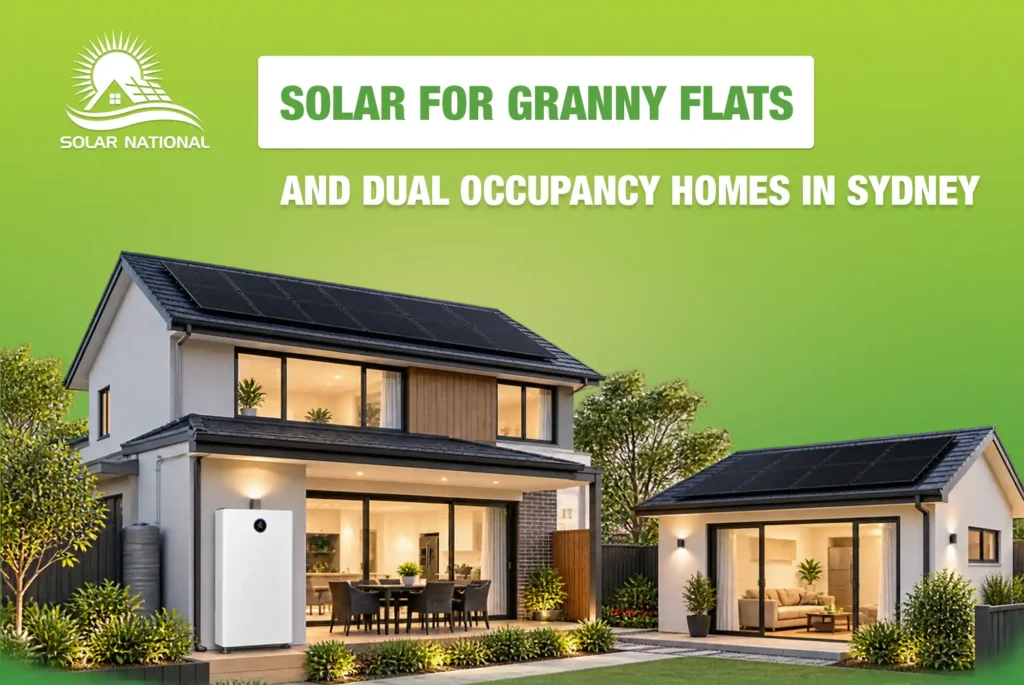
Sydney homeowners are building granny flats and dual occupancy homes at a pace not seen in decades. With housing density increasing across suburbs from Penrith to the Northern Beaches, the question of how to power these additional dwellings efficiently has become just as important as the build itself. Solar panel installation for granny flats and dual occupancy properties is one of the smartest investments you can make, cutting electricity costs for multiple households sharing a single block while taking full advantage of Sydney’s generous sunshine.
Whether you are adding a secondary dwelling for ageing parents, building a detached granny flat for rental income, or developing a dual occupancy home as an investment, understanding how solar energy fits into these setups can save you thousands of dollars over the life of the system. This guide covers everything from system sizing and metering configurations to rebates, battery storage and what to look for in a qualified installer.
Why Granny Flats and Dual Occupancy Homes Are Booming in Sydney
Sydney’s housing affordability challenge has turned granny flats and dual occupancy developments into a practical solution for families, investors and first-home buyers alike. Under the NSW Housing SEPP, a complying granny flat of up to 60 square metres can be approved on residential lots of 450 square metres or more through a fast-track Complying Development Certificate, often without a full council Development Application. This streamlined pathway has made secondary dwellings one of the fastest-growing segments of residential construction across Western Sydney, the Hills District, Sutherland Shire and the Inner West.
Dual occupancy homes, where two separate dwellings sit on a single title, offer a similar appeal. Whether attached (side by side or front and back) or detached, they allow property owners to live in one dwelling and rent the other, house extended family or simply maximise the return on their land.
With two households drawing power from the same block, electricity costs add up quickly. That is exactly where a well-designed solar power system makes a measurable difference.
How Solar Works for a Granny Flat
A granny flat does not need an enormous rooftop array to benefit from solar. Most secondary dwellings in Sydney have modest energy needs: lighting, a split-system air conditioner, a small kitchen and perhaps a hot water system. A compact system of 3kW to 5kW of high-quality solar panels paired with a reliable solar inverter is usually enough to offset the bulk of a granny flat’s daytime consumption.
Roof Considerations
Granny flat roofs tend to be smaller and lower-pitched than the main house. That is not necessarily a disadvantage. Modern high-efficiency panels from brands like Jinko, Trina and REC produce more watts per square metre than older modules, meaning fewer panels can still deliver strong output. A north-facing granny flat roof in Sydney will capture the most sunlight, though east or west orientations still perform well given Sydney’s latitude.
If the granny flat roof is partially shaded by the main dwelling or nearby trees, micro-inverters or panel-level optimisers can minimise the impact of shading on overall system performance.
Metering for Granny Flat Solar
How the solar system connects to the electricity grid depends on the metering arrangement. If the granny flat shares the same electricity meter as the main house, a single solar system on either roof can serve both dwellings. All generated solar energy offsets the combined household consumption, and any excess is exported for a feed-in tariff credit on a single bill.
If the granny flat has its own separate National Metering Identifier (NMI) and independent meter, it is treated as a distinct premises by the electricity retailer. In that case, each dwelling needs its own solar system and its own grid connection approval. Your solar installer will need to lodge a separate connection application with Ausgrid or Endeavour Energy depending on your suburb.
Solar for Dual Occupancy Homes: Shared vs Separate Systems
Dual occupancy properties present a unique opportunity to design a solar energy system that benefits both dwellings from day one. The right configuration depends on whether the two homes share a single electricity meter or operate on independent connections.
Single Meter
If both dwellings are on one meter, a single larger system, typically 10kW to 13kW, can be installed across the available roof space. This is often the most cost-effective approach because you avoid duplicating inverters and connection fees. The combined household consumption means more of the solar generation is used on-site rather than exported, which improves the financial return. One consideration is that a single bill means both occupants need an arrangement for splitting costs. Sub-metering can help keep things fair.
Separate Meters
When each dwelling has its own meter, each side needs its own solar system with a dedicated inverter. This is common when one dwelling is owner-occupied and the other is a rental. The advantage is complete billing independence: each occupant receives their own electricity bill and their own feed-in tariff credits. The installer will submit two separate grid connection applications.
For properties where roof space is limited, installing panels on the main house roof and splitting the array between two inverters (one for each meter) is a workable solution that many experienced installers in Sydney are familiar with.
Rebates and Incentives for Solar in NSW
Sydney homeowners adding solar to a granny flat or dual occupancy home can access multiple layers of government support that significantly reduce upfront costs.
Federal STC Rebate for Solar Panels
The Small-scale Renewable Energy Scheme (SRES) provides Small-scale Technology Certificates (STCs) that lower the purchase price of a new solar panel system at the point of sale. The discount depends on system size, location and installation date. For a typical 6.6kW system in Sydney, this translates to savings of roughly $2,000 to $2,400. The STC scheme is scheduled to taper each January and concludes in 2030, so acting sooner locks in a larger discount. Check current rebate eligibility for the latest figures.
Federal Cheaper Home Batteries Program
The Cheaper Home Batteries Program offers an upfront discount on eligible home battery systems. This federal incentive is delivered through the same STC framework and applies across Australia. For granny flat and dual occupancy setups, pairing solar with a battery is especially valuable because stored energy can be used across evening peak hours when grid electricity is most expensive.
NSW VPP Incentive (PDRS)
NSW residents can stack a separate state incentive on top of the federal battery rebate by enrolling an eligible battery in an approved Virtual Power Plant (VPP). This one-off incentive rewards homeowners who allow their battery to contribute stored energy back to the grid during peak demand events.
NSW Home Energy Saver Loan
NSW also offers an interest-free loan of up to $15,000 that can be applied toward solar panels, batteries or both. Repaid over up to 10 years with no fees, this program makes it easier to fund a solar installation on a granny flat or dual occupancy property without a large upfront outlay.
Battery Storage: A Game Changer for Multi-Dwelling Properties
Solar panels generate electricity during the day, but granny flats and dual occupancy homes often have occupants with different schedules. One household might be home during the day while the other works nine to five and returns in the evening. A solar battery bridges that gap by storing surplus daytime generation for use after sunset.
For a granny flat on a shared meter, a single battery like the Tesla Powerwall 3 or a BYD battery can serve both dwellings. The stored energy is drawn from automatically whenever grid power would otherwise be needed, reducing the combined electricity bill even further. A 10kWh to 13.5kWh battery is a common choice for households in Sydney looking to cover evening and overnight consumption.
For dual occupancy homes on separate meters, each dwelling would ideally have its own battery paired with its own solar array. Options like the Sungrow battery or SiGenergy battery offer compact, modular solutions that suit the space constraints of multi-dwelling blocks.
Battery storage also provides backup power during outages, a practical benefit for properties housing elderly family members or tenants who rely on medical equipment at home.
Council Approvals and Installation Considerations
The good news is that solar panel installations in NSW are generally classified as exempt development under the State Environmental Planning Policy (Transport and Infrastructure) 2021. This means most rooftop solar systems on granny flats and dual occupancy homes do not need a Development Application or Complying Development Certificate, provided they meet standard setback and height requirements.
However, there are a few practical factors to keep in mind when installing solar on multi-dwelling properties in Sydney.
Roof Structural Integrity
Granny flats built to minimum specifications may have lighter roof framing than a standard home. A qualified installer will assess whether the roof can support the weight of solar panels and mounting rails before committing to a design. Lightweight panels and flush-mount racking systems can reduce the load where needed.
Electrical Compliance
All solar installations in NSW must be carried out by a Clean Energy Council (CEC) accredited installer. For dual occupancy properties with separate meters, the electrical work must comply with the wiring rules for each individual connection point. Your installer should coordinate with the local distribution network operator (Ausgrid in eastern Sydney, Endeavour Energy in western Sydney) to ensure the grid connection is approved before the system is switched on.
Shading from the Main Dwelling
On tight blocks, the main house can cast shadows onto the granny flat roof, especially during winter months when the sun sits lower in the sky. A professional site assessment using shade analysis tools will identify the best panel placement to maximise generation year-round.
Cost Savings and Return on Investment
The financial case for solar on granny flats and dual occupancy homes is compelling, often more so than for a standalone house. When two households share a block, the combined electricity consumption is higher, which means a larger proportion of the solar generation is consumed on-site rather than exported at a lower feed-in tariff rate. This higher self-consumption ratio directly improves the payback period.
A well-sized residential solar system on a dual occupancy property in Sydney can save between $2,400 and $4,000 per year on combined electricity bills, depending on system size, household usage patterns and whether a battery is included. Most homeowners see a full return on their solar investment within three to five years, after which the savings are essentially free for the remaining 20-plus years of the system’s lifespan.
Solar also adds tangible value to the property itself. Buyers and tenants in Sydney increasingly look for homes with existing solar, and a dual occupancy or granny flat property with solar already installed is more attractive in a competitive rental market.
For landlords, offering a solar-powered granny flat means lower running costs for tenants, which can justify a slightly higher weekly rent while still leaving the tenant better off than they would be paying full grid electricity rates.
Choosing the Right Solar Installer for Granny Flat and Dual Occupancy Projects
Not every solar installer has experience with the specific requirements of granny flat and dual occupancy installations. Multi-dwelling setups involve decisions around metering, split arrays, separate inverters and sometimes challenging roof access that a standard single-home install does not.
When choosing an installer in Sydney, look for a company that is CEC accredited, carries appropriate insurance and workmanship warranties, and has a track record with multi-dwelling residential projects. At Solar National, the team works closely with homeowners to design solar solutions tailored to the unique layout and energy needs of granny flats and dual occupancy homes across Sydney and greater NSW.
Ask potential installers about their experience with dual-meter configurations, split-array designs and the grid connection process with both Ausgrid and Endeavour Energy. A good installer will conduct a thorough site inspection, provide a detailed proposal with expected savings, and handle all paperwork including rebate applications and network connection approvals.
Finally, insist on quality products backed by solid warranties. Tier 1 solar panels with 25-year product and performance warranties, a reputable inverter brand with at least a 10-year warranty, and a workmanship guarantee from the installer all protect your investment for decades to come. Explore available finance options to find a payment plan that suits your budget.
Frequently Asked Questions
Can I install solar panels on my granny flat in Sydney without council approval?
In most cases, yes. Rooftop solar panel installations in NSW are classified as exempt development under the State Environmental Planning Policy (Transport and Infrastructure) 2021, provided they meet standard height and setback requirements. You typically do not need a Development Application or Complying Development Certificate for a standard residential solar installation on a granny flat.
Do I need a separate solar system for my granny flat if it has its own electricity meter?
Yes. If your granny flat has an independent National Metering Identifier (NMI) and its own electricity meter, it is treated as a separate premises. Each metered dwelling requires its own solar system and its own grid connection approval through the local distribution network operator.
What size solar system do I need for a granny flat?
Most granny flats in Sydney operate well with a 3kW to 5kW solar system. The ideal size depends on the dwelling’s electricity consumption, the available north-facing roof space, and whether you plan to add battery storage. A site assessment from a qualified installer will determine the best system size for your specific setup.
Can one solar system power both dwellings in a dual occupancy home?
Yes, if both dwellings share a single electricity meter. A larger system of 10kW to 13kW can be installed across the available roof area, with all generated solar energy offsetting the combined consumption. If the dwellings have separate meters, each needs its own dedicated solar system.
Is battery storage worth it for a granny flat or dual occupancy property?
Battery storage is particularly worthwhile for multi-dwelling properties because the combined energy demand across two households means more opportunities to use stored solar energy rather than drawing from the grid during expensive peak hours. Batteries also provide backup power during outages, which is especially valuable for households with elderly residents.
What rebates are available for solar on granny flats and dual occupancy homes in NSW?
NSW residents can access the federal STC rebate on solar panels (saving roughly $2,000 to $2,400 on a 6.6kW system), the federal Cheaper Home Batteries Program for battery storage, the NSW VPP incentive (PDRS) for eligible batteries enrolled in a Virtual Power Plant, and the NSW Home Energy Saver interest-free loan of up to $15,000 for solar and battery purchases.
Will adding solar to my granny flat increase my property value?
Yes. Properties with solar installations are increasingly attractive to buyers and tenants in Sydney. A granny flat or dual occupancy home with solar already in place lowers the ongoing running costs, which can justify higher rental yields and adds to overall property value at resale.