



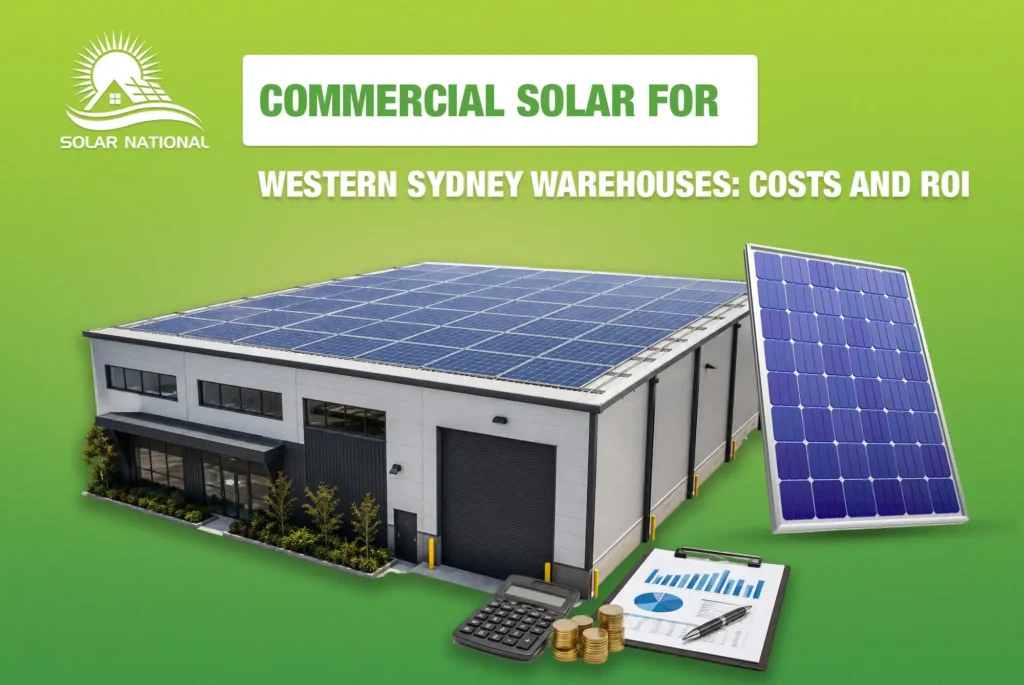
Warehouses are one of the best commercial buildings for solar. They combine large, unshaded roofs with high daytime power use, which is exactly when solar produces. For many Western Sydney operations, a well-designed system pays for itself in a few years and then cuts power costs for decades. This guide covers what commercial solar costs, what drives the return, the incentives available, and the practical roof and metering issues to plan for.
Why warehouses suit solar so well
Three things make warehouses a strong fit. The roofs are large and mostly flat or gently pitched, giving plenty of room for a sizeable array without the shading problems that affect suburban rooftops. The power use, from lighting, refrigeration, machinery and forklift charging, happens through the day while the sun is up, so most of the solar is used on site rather than exported for a low return. And commercial electricity tariffs often include demand charges, which a well-designed system can help reduce.
Western Sydney is home to a large share of Sydney’s industrial and logistics floorspace, and those buildings tend to have exactly this profile: big roofs and steady daytime load. That combination is why commercial solar has become a standard cost-control move for operators in the area.
How much does commercial solar cost for a warehouse?
Commercial systems are usually priced per kilowatt, and the rate falls as the system gets bigger, since fixed costs are spread across more panels. As a broad guide, warehouse systems commonly range from around 30kW for a smaller unit up to 100kW or more for a large facility, with the price per kilowatt lower at the top end. The accurate figure depends on your roof, switchboard, cabling runs and how the system is designed, so a site-specific quote is the only way to know your number.
The panels and inverters you choose matter for both cost and long-term output. Better components produce more over the system’s life and fail less often, which usually outweighs a cheaper upfront price on a commercial asset expected to run for decades. You can see the solar panels and solar inverters we use for commercial projects.
What ROI can a Western Sydney warehouse expect?
Rather than a single payback number, which varies too much between sites to be meaningful, it is more useful to understand what drives the return:
- Daytime self-consumption: the more solar you use on site instead of exporting, the faster the payback. Warehouses that run through the day score well here, and this is usually the single biggest factor.
- Your tariff and demand charges: the higher your daytime energy rate and demand charges, the more each unit of solar saves you.
- System size and design: a system sized to match your daytime load, rather than overshooting into low-value exports, gives the best return.
- Incentives: upfront certificates reduce the capital cost and shorten payback.
For most well-matched commercial systems, payback lands within a few years, after which the electricity is effectively free for the remaining life of the system, which is typically 25 years or more for the panels. A proper feasibility assessment against your actual bills and interval data will give you a firm figure rather than a rule of thumb.
Understanding demand charges
Many commercial electricity bills include a demand charge, which is based on your highest rate of power draw in a period, not just your total energy use. It can be a significant slice of the bill. Solar helps in two ways: it lowers the energy you buy overall, and by shaving the peaks during daylight it can reduce the demand charge as well. Pairing solar with a battery or smart controls can push this further by managing those peaks more actively. When modelling ROI, demand-charge savings are often overlooked, yet for a warehouse they can be a meaningful part of the return.
Incentives for commercial solar
The incentive depends on system size. Systems up to 100kW earn Small-scale Technology Certificates under the SRES, applied as an upfront discount in the same way as residential systems. Larger systems above that threshold instead generate Large-scale Generation Certificates over time, which are sold separately and provide an ongoing revenue stream rather than an upfront discount. There may also be business measures such as instant asset write-offs or efficiency programs available depending on the year and your circumstances, so it is worth checking what applies to your project with your accountant alongside your installer.
Do you own or lease the building?
Whether you own or lease the warehouse shapes the decision. Owner-occupiers get the most straightforward case, since they carry both the cost and the savings. For leased premises, the split between landlord and tenant needs sorting first: the tenant usually pays the power bill and gains the savings, while the landlord owns the roof. A clear agreement, or a solar arrangement structured around the lease, makes these projects work. It is worth raising early so it does not stall the business case.
Roof, metering and structural considerations
A commercial install needs a few checks a home does not. The roof structure must be able to carry the array, which a structural assessment confirms, and the roof sheeting type and condition affect the mounting method and whether any work is needed first. The switchboard and metering may need upgrading to handle the system and to export correctly, and most commercial sites are three-phase, which the system must be designed around. Your network may also apply an export limit, capping how much you can send to the grid, which is another reason to size the system to your own daytime use rather than for export. Getting these sorted early keeps the project on schedule.
Should you oversize for future growth?
If you expect your power use to grow, whether from adding refrigeration, more machinery, or electric vehicles and forklifts, it can be worth sizing the system with some headroom. Installing once is cheaper than returning to expand a system later, and roof space is finite. On the other hand, oversizing well beyond your daytime load pushes more generation into low-value exports. The sweet spot is a system matched to your current daytime use with a sensible allowance for known growth, which a feasibility assessment can map out.
How to fund a commercial system
There is more than one way to pay for commercial solar, and the right one depends on your cash flow and tax position. Buying the system outright gives the fastest payback and the full savings, and is the simplest option for businesses with the capital available. Financing spreads the cost over time, often structured so the monthly repayment is lower than the energy savings, which keeps the project cash-flow positive from early on. Some businesses also explore power purchase arrangements, where a third party owns the system and you pay for the energy it produces, though for a warehouse with strong daytime use, owning the asset usually delivers the best long-term return. It is worth modelling a couple of options against your numbers before deciding.
Monitoring and maintenance
A commercial system is a long-term asset, and keeping it performing protects the return. Good systems come with monitoring that shows generation and flags faults, so a drop in output is caught quickly rather than quietly costing you for months. Commercial arrays need occasional cleaning, since dust and bird droppings build up on large flat roofs and can pull down output, and periodic electrical checks keep everything safe and within warranty. Building a light maintenance schedule into the project from the start means the system keeps delivering its modelled savings across its full life.
Frequently asked questions
How much does commercial solar cost for a warehouse?
Systems are priced per kilowatt, with the rate falling as size increases. Warehouse systems commonly range from around 30kW to 100kW or more. A site-specific quote is the only accurate way to price it, since roof, switchboard and design all affect the figure.
What is the ROI on commercial solar in Western Sydney?
Payback for a well-matched system usually lands within a few years, driven by daytime self-consumption, your tariff and demand charges, and the upfront certificate discount. A feasibility assessment against your bills gives a firm number.
What incentives are available for commercial solar?
Systems up to 100kW earn Small-scale Technology Certificates as an upfront discount. Larger systems generate Large-scale Generation Certificates over time. Additional business measures such as asset write-offs may also apply.
Can a warehouse roof handle solar panels?
Most can, but a structural assessment confirms the roof can carry the array and checks the sheeting condition. This is a standard part of a commercial solar design.
What is a demand charge and does solar reduce it?
A demand charge is based on your highest rate of power draw, not just total usage. Solar can reduce it by shaving daytime peaks, and pairing solar with a battery or smart controls can push those savings further.
Get a commercial solar assessment
The team at Solar National can assess your warehouse roof, load profile and tariff, and model the return before you commit. See our commercial solar installation service, or contact us for a feasibility assessment.