


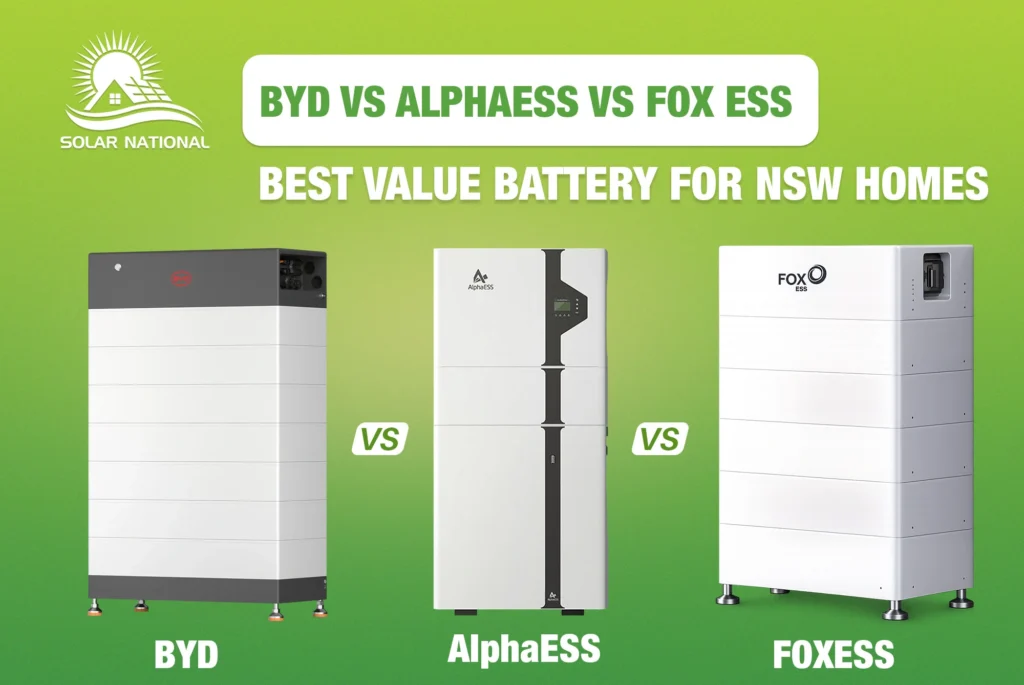
BYD, AlphaESS and Fox ESS are three of the most popular home battery brands in NSW, and all three are well-built lithium iron phosphate (LFP) batteries backed by a 10-year warranty. There is no single “best” among them. The best value battery is the one that fits your home’s energy use, your inverter, your need for backup power, and your budget. This guide compares the three in plain terms, explains the features that actually change your day-to-day experience, and gives you a simple way to decide which one suits you.
BYD vs AlphaESS vs Fox ESS at a glance
| BYD | AlphaESS | Fox ESS | |
| Chemistry | LFP (lithium iron phosphate) | LFP | LFP |
| Design | Modular, stackable (Battery-Box range) | Modular, with all-in-one options (SMILE range) | Modular, stackable |
| Warranty | Typically 10 years | Typically 10 years | Typically 10 years |
| Known for | Build quality and global manufacturing scale | Balanced all-in-one systems and local support | Competitive pricing and value |
| Best suited to | Homeowners wanting a premium, proven brand | Those wanting a tidy, integrated setup | Value-focused buyers |
Because specifications and pricing change with each new model, the current capacities and prices for each are on their product pages: BYD, AlphaESS and Fox ESS. The sections below focus on the things that do not change month to month, which is where the real decision sits.
Why they all use LFP chemistry, and why that matters
All three brands use lithium iron phosphate cells, usually shortened to LFP. This has become the standard for home batteries in Australia for good reason. LFP is one of the most thermally stable lithium chemistries, which means a strong safety record, and it handles a high number of charge and discharge cycles before it starts to fade. It also copes well with being used every day, which is exactly what a solar battery does as it fills up in the afternoon and empties over the evening.
The practical upshot is that when you compare BYD, AlphaESS and Fox ESS, you are not choosing between safe and unsafe or long-lasting and short-lived. All three are in the safe, long-life category. The differences come down to design, capacity options, backup features and price, not the core chemistry.
BYD home batteries
BYD is one of the largest battery manufacturers in the world, supplying cells for electric vehicles as well as home storage, and that scale shows in its Battery-Box range. The batteries are modular, so you start with the capacity you need and stack more later if your usage grows, for example after buying an electric vehicle. Build quality is a common reason installers and homeowners rate BYD highly.
For someone who wants a premium battery from a globally established manufacturer with deep engineering behind it, BYD is a safe, long-term choice. It tends to sit at the upper end on price, which is fair given the brand and build, so it appeals most to buyers who value a proven name and are less focused on getting the lowest possible cost.
AlphaESS home batteries
AlphaESS has built a strong presence in Australia and is known for well-supported, balanced systems. Its SMILE range includes all-in-one options that combine the battery and a hybrid inverter in a single unit. That integration can simplify the installation, reduce the number of boxes on your wall, and make the whole system feel tidier, which many homeowners appreciate.
Local support is another point in its favour. A battery is a long-term purchase, so having a brand with solid Australian backing and service matters over a 10-year-plus life. If you like the idea of one integrated unit from a company with good local presence, AlphaESS deserves a close look and often lands in the sensible middle on price.
Fox ESS home batteries
Fox ESS has grown quickly in Australia largely on value. Its modular batteries use the same LFP chemistry and stackable approach as the others, usually at a sharper price. That makes Fox ESS a favourite for homeowners who want quality storage without paying top dollar, and it is a brand that shows up often on competitive quotes.
Choosing Fox ESS does not mean settling for less on the fundamentals. You still get LFP cells, a 10-year warranty and a modular design. What you are trading is the premium-brand cachet of BYD for a keener price, which for many households is exactly the right call. If getting the most usable storage for your budget is the priority, Fox ESS is often the value pick.
How the battery connects: hybrid vs AC-coupled
One detail that affects both cost and which battery suits you is how it connects to your solar. There are two common approaches. A hybrid (or DC-coupled) setup uses a single hybrid inverter that manages both your solar panels and the battery. It is efficient and neat, and it suits new installations or homes ready to replace an ageing inverter. An AC-coupled setup adds a separate battery inverter alongside your existing solar inverter, which is often the better path when you are retrofitting a battery to a solar system that already works well.
Each brand fits into these approaches a little differently, and some pair best with specific inverters. This is where good advice pays off, because the right match avoids extra hardware and keeps the install clean. If you are unsure which route suits your home, our team can walk you through it against your current setup.
What size battery do you need?
Size the battery to your evening and overnight use, not to the largest unit available. The goal is to store enough of your daytime solar surplus to cover the hours when the sun is down, without paying for capacity you never fully use. A household that is out during the day and uses most of its power at night benefits from more storage, while a home that already runs big loads in daylight may need less.
Getting the panel and battery sizing right together is the key to value. Our guide to what size system you need covers how to match generation and storage to your usage. All three brands offer a range of capacities, which is why comparing them against your actual bills, rather than on headline specs, gives the truest picture. You can also browse all of our solar battery options in one place.
Do you need backup power in a blackout?
A common surprise is that not every battery keeps your lights on during a blackout by default. Backup power needs a battery and inverter setup designed for it, often with a dedicated backup circuit or gateway, so that the system can safely disconnect from the grid and run your home on stored energy. BYD, AlphaESS and Fox ESS all have backup-capable options, but it is a feature to confirm and design for, not assume.
If keeping essential circuits running through an outage is important to you, raise it early. It can influence which model and inverter you choose, and it is far easier to plan in from the start than to add later.
How to choose the best value battery for your home
Value is not just the sticker price. To land on the right battery, weigh up:
- Capacity you actually need: match the battery to your evening usage. An oversized battery you never fully cycle is wasted money.
- Inverter compatibility: the right battery-and-inverter match avoids extra hardware and keeps the system efficient.
- Warranty terms: compare not just the years but the retained capacity guaranteed at the end of the term, which tells you how much life you are really being promised.
- Backup needs: if you want blackout protection, make sure the model and design support it.
- Rebate eligibility: only Clean Energy Council approved batteries qualify for the federal battery rebate, and all three brands have eligible models.
The simplest way to compare fairly is to get a quote for each against your own home and bills. That turns three sets of specs into three real prices and outcomes you can weigh side by side.
The battery rebate and VPPs in NSW
The federal battery rebate moved to a tiered structure in 2026, replacing the earlier flat rate. It applies to eligible batteries installed with solar and is delivered as an upfront discount, so it lowers what you pay at purchase rather than being claimed back later. Because the amount and eligibility rules can change, check the current details on our federal battery rebate page before you buy.
Adding a battery can also make you eligible to join a virtual power plant. A VPP pays you for letting your battery share stored energy back to the grid at peak times, which adds another small income stream on top of your bill savings. All three brands have models that work with VPP programs, so it is worth factoring in if extra returns appeal to you.
Common mistakes when choosing a battery
- Buying on brand alone: a big name is reassuring, but the right size and setup matter more than the badge.
- Oversizing: a battery bigger than your overnight use looks impressive but stretches the payback.
- Ignoring the inverter: the battery is only half the system. A poorly matched inverter undercuts even a great battery.
- Forgetting backup: if you assumed blackout protection and did not design for it, you may not have it.
- Chasing the lowest quote: the cheapest install can cost more later. Compare the equipment and workmanship, not just the price.
Frequently asked questions
Which is the best value home battery in NSW?
There is no single best. BYD, AlphaESS and Fox ESS are all quality LFP batteries with 10-year warranties. Fox ESS is often the value pick on price, BYD suits those wanting a premium global brand, and AlphaESS appeals to homeowners after a tidy all-in-one system.
Are BYD, AlphaESS and Fox ESS batteries safe?
Yes. All three use lithium iron phosphate (LFP) chemistry, which is regarded as one of the safest and longest-lasting battery types for home storage.
Do these batteries provide backup power in a blackout?
They can, but backup is not automatic. It needs a battery and inverter setup designed for it, often with a dedicated backup circuit. All three brands have backup-capable options, so confirm this when you get your quote if it matters to you.
Do these batteries qualify for the battery rebate?
All three brands have Clean Energy Council approved models that qualify for the federal battery rebate. Confirm the specific model is on the approved list when you get your quote.
How long do these home batteries last?
Home batteries generally last around 10 to 15 years, and LFP batteries like these are built for a long cycle life. The warranty, usually 10 years, gives you a guaranteed minimum, often expressed as the capacity the battery will still hold at the end of the term.
What size battery should I get?
Size it to your evening and overnight usage rather than the largest available. A home that uses most of its power after dark benefits from more storage, while a home with high daytime use may need less. A quote based on your bills gives the right figure.
Compare batteries for your home
The team at Solar National can quote BYD, AlphaESS and Fox ESS against your actual usage so you can compare value like for like, including inverter matching and backup options. Contact us for a free battery quote.