


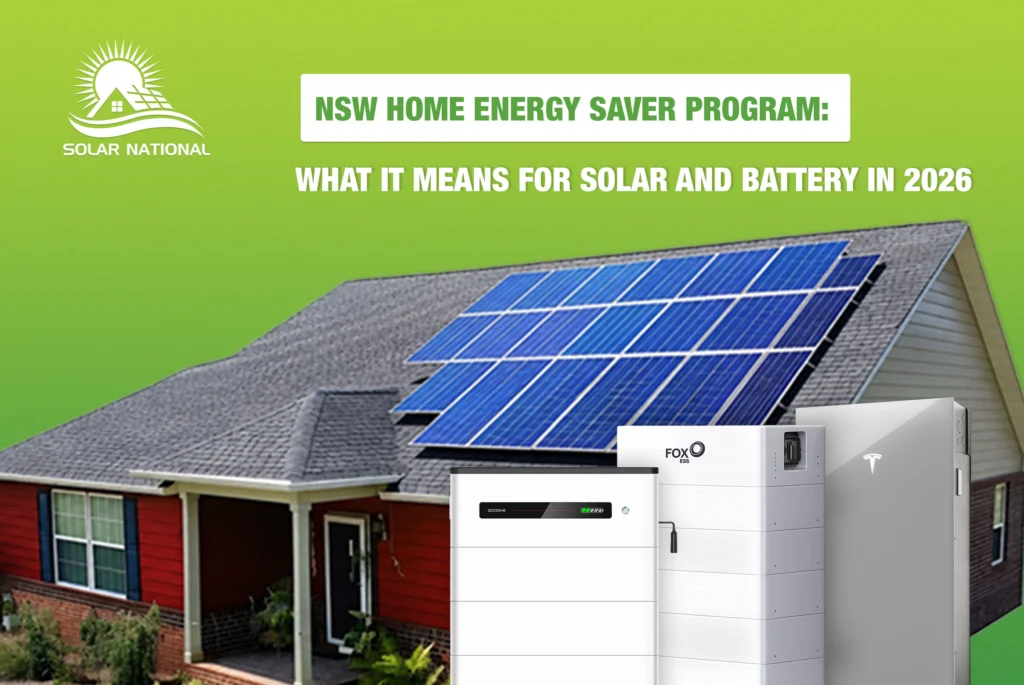
For a lot of NSW households, the maths on solar and batteries already makes sense. The thing holding them back is the upfront cost. The NSW Government’s new Home Energy Saver Program is built to remove exactly that barrier, with interest-free loans of up to $15,000 and extra discounts for lower-income households.
Announced in June 2026, the program expands on the earlier Empowering Homes scheme by lifting both the loan cap and the income threshold, so far more households now qualify. Here is how it works, what it covers, who is eligible, and how it stacks with the federal rebates you may already know about.
At a glance
- Interest-free (0%) loans of up to $15,000 for energy upgrades
- Repayment terms of up to 10 years
- Up to $4,000 in additional discounts for eligible lower-income households
- Covers solar panels, home batteries, insulation, air conditioning and more
- Can be combined with federal incentives such as the Cheaper Home Batteries Program and STCs
- Open to NSW owner-occupiers and landlords with a household income of $210,000 or less
- Applications are open across NSW now
What is the Home Energy Saver Program?
The Home Energy Saver Program is a NSW Government finance scheme aimed at one specific problem: the size of the cheque you have to write on day one.
Solar panels, batteries and efficient electric appliances all save money over time, but the initial investment can run into thousands of dollars. The program lets eligible households borrow that amount at 0% interest and pay it back over several years, so the savings can start before the system is fully paid off.
It is not a traditional bank loan. There is no interest charged on the amount you borrow. You repay only the approved loan amount over the agreed term, which can be up to 10 years.
How much you can get
There are two parts to the financial support.
The first is the interest-free loan. Eligible households can access up to $15,000 at 0% interest, repayable over up to 10 years. The exact amount available depends on the technologies you install and your eligibility.
The second is for lower-income households, who may also qualify for discounts of up to $4,000. These are designed to cut the upfront cost further and can sit on top of the interest-free loan.
What the loan can be used for
One of the better features of this program is how broad it is. Rather than backing a single product, it supports a range of upgrades.
Solar panels. Finance a rooftop solar system so you generate your own electricity and lean less on the grid. Solar remains one of the most reliable ways to bring a power bill down, especially when you use most of your energy during the day.
Home batteries. Store the solar energy you generate during the day and use it in the evening when grid power is usually most expensive and demand peaks. Batteries are still a significant purchase, so interest-free finance makes ownership far more reachable.
Energy efficiency upgrades. The program also covers improvements that reduce how much energy you use in the first place, including insulation, draught-proofing, reverse-cycle air conditioning, ceiling fans, switchboard upgrades, and double-glazed windows and doors.
Who is eligible
To qualify for the interest-free loan, you generally need to:
- Be an Australian citizen or permanent resident
- Own a property in NSW where the upgrade will be installed, as either an owner-occupier or a landlord
- Have a combined taxable household income of $210,000 or less
- Meet your finance provider’s standard credit assessment
A few conditions apply. The property cannot be social or community housing, or used for short-stay accommodation. Strata properties can apply, but you will need approval from your owners corporation first. The NSW Government also offers an Energy Savings Finder tool so you can check your eligibility before you apply.
Eligibility rules can change, so it is worth confirming the current requirements on the official NSW program page before you lodge an application.
How it works with other incentives
This is the part worth getting right, because it changes the numbers.
The Home Energy Saver loan does not stack on top of the full system price. Any federal or NSW incentives you qualify for, such as the Cheaper Home Batteries Program or Small-scale Technology Certificates (STCs) for solar, are applied first. They bring the system cost down, and the loan then covers what is left.
Here is a simple worked example. Say a solar and battery system is priced at $14,000. Federal incentives reduce that to a net cost of, for argument’s sake, $7,000. You can then use an interest-free Home Energy Saver loan to cover that $7,000 and pay it back over up to 10 years, rather than handing it over upfront.
One thing to note: the loan covers the eligible upgrade and its installation only. It does not usually cover separate pre-work, such as rewiring, unless that work is itself a listed upgrade like a switchboard replacement.
What this means for solar and battery owners
The timing matters. The program arrives while battery support is also strong at the federal level, and the two work well together.
For a household considering storage, the combination is powerful. A federal incentive can knock a large chunk off the price of a battery, and the interest-free loan can then spread the rest across several years. The result is a much smaller initial outlay and, in many cases, a shorter payback period.
In plain terms, projects that households were planning to put off for a few years can often be brought forward to now.
Things to consider before you apply
The program is genuinely useful, but a few points are worth thinking through first.
It is a loan, not a giveaway, so repayments still apply even though there is no interest. Not every household or technology will qualify, so check the criteria early. And as with any home upgrade, compare your expected energy savings against the repayments so you know the system pays for itself comfortably.
Getting more than one quote, and comparing the actual systems rather than just the headline price, remains the smart approach.
How to take the next step
The simplest way to use this program well is to start with a quote that already has the federal rebates applied, so you can see your real net cost and work out the loan amount from there.
Solar National can design a solar and battery system for your home, apply the incentives you qualify for, and walk you through how the Home Energy Saver loan fits on top, so you know your true out-of-pocket cost before you commit.
Frequently asked questions
Is the Home Energy Saver Program a rebate?
Not exactly. The main offer is an interest-free loan rather than a cash rebate, although eligible lower-income households may also receive discounts of up to $4,000.
What is Home Energy Saver?
It is a NSW Government program that gives eligible households interest-free finance of up to $15,000 to install solar, batteries and other energy-saving upgrades, repayable over up to 10 years.
Is the $15,000 a grant or a loan?
It is an interest-free loan. You repay the amount you borrow over the agreed term, but you are not charged any interest on it.
Can I use the loan for a home battery?
Yes. Home battery storage is one of the main technologies the program supports.
Can I use the loan for solar panels?
Yes. You can use the loan to finance a rooftop solar system, on its own or paired with a battery.
Can I combine the program with other incentives?
Yes. Federal and NSW incentives such as the Cheaper Home Batteries Program and STCs are applied first to reduce the system cost, and the loan then covers the remaining balance.
Can renters access Home Energy Saver?
The loan is for property owners. Landlords can apply for an eligible NSW property, but renters cannot apply directly themselves.