


As Australia accelerates its transition to renewable energy, solar batteries have become essential for homeowners aiming to maximise their solar investment. With electricity prices in Sydney soaring (up 20% since 2023) and feed-in tariffs shrinking, a solar battery for home use can significantly cut bills, provide blackout protection, and enhance energy independence. At Solar National, we’re dedicated to helping Australians, particularly in Sydney, choose the best solar batteries for 2026. This guide dives into the top solar battery options, including the cost-effective SAJ battery, their specifications, costs, and key considerations for Sydney households.
What Are the Main Benefits of a Solar Battery?
Investing in a solar battery offers several advantages for your home:
- Energy Bill Savings: By storing excess solar energy and using it during high-tariff periods, solar batteries help reduce electricity bills. Use our Battery Payback Calculator to estimate your savings and ROI.
- Power Outages: Solar batteries can provide backup power during blackouts, ensuring essential appliances stay running when the grid fails.
- Virtual Power Plants (VPPs): Participate in VPPs where your battery can provide grid services. Operators may occasionally control your battery in exchange for payment.
- Carbon Footprint Reduction: By using stored solar energy instead of grid power, you lower your reliance on non-renewable sources and reduce your carbon emissions.
These benefits make solar batteries a smart investment for savings, reliability, and sustainability.
Why Invest in a Solar Battery in 2026?
Solar batteries store surplus energy generated by your solar panels during the day, allowing you to use it at night, during peak tariff hours, or in outages. With Australia’s electricity costs rising and blackout risks increasing due to extreme weather, batteries offer both financial and practical benefits. The federal Cheaper Home Batteries Program, launched on July 1, 2025, provides a rebate of approximately $350 per usable kWh, reducing costs by about 30%. NSW’s $1,600–$2,400 rebate and emerging virtual power plant (VPP) incentives (up to $434 annually) make 2026 an ideal time to invest. Solar National’s Sydney-based team ensures seamless installations tailored to your energy needs.
Top Home Batteries for 2026
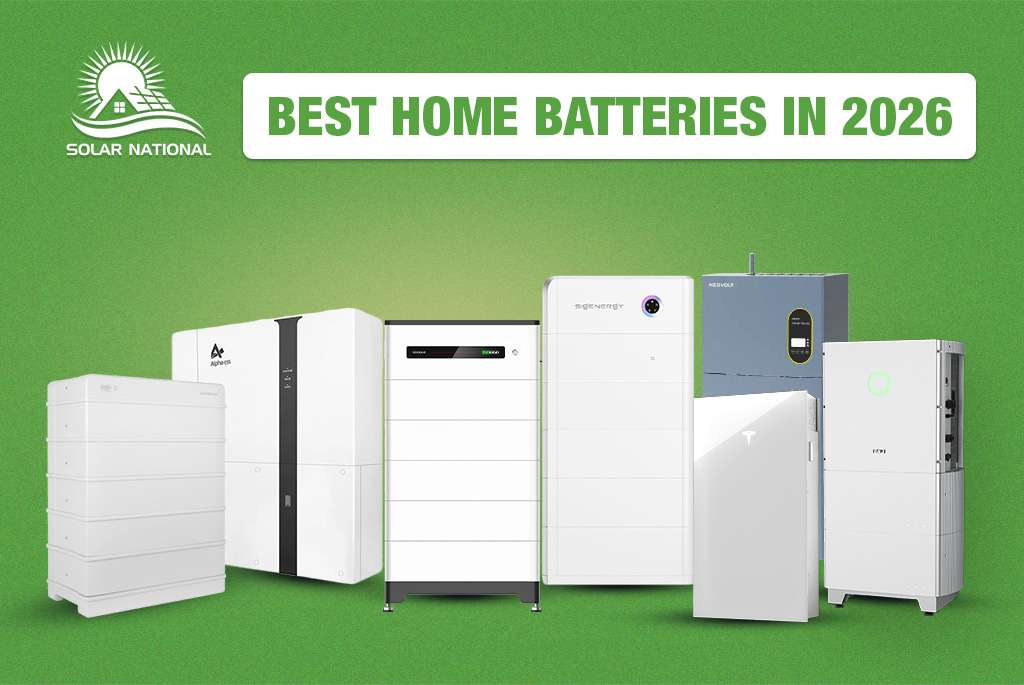
Based on performance, affordability, and installer feedback, here are the best solar batteries for Australian homes in 2026, with a focus on Sydney households:
1. Tesla Powerwall 3

- Capacity: 13.5 kWh (usable)
- Cost: ~$11,500 (pre-rebate, installed)
- Key Features: Integrated hybrid inverter, 11.5 kW continuous output, 89% round-trip efficiency, and advanced Tesla app for real-time monitoring and load control.
- Why It Stands Out: The Powerwall 3 suits high-energy Sydney homes with its all-in-one design and robust blackout protection (185% peak surge capacity). Its 10-year warranty guarantees 70% capacity retention, making it a premium choice for reliability.
Pros:
- High Capacity: 13.5 kWh (usable) ideal for large households.
- Advanced Features: Integrated hybrid inverter, real-time monitoring via the Tesla app.
- Reliability: 10-year warranty and 70% capacity retention guarantee.
- Peak Surge Capacity: 185% surge capacity, ensuring robust blackout protection.
- Efficiency: 89% round-trip efficiency, reducing energy losses.
Cons:
- High Upfront Cost: At ~$11,500, it is one of the more expensive options.
- Space Requirement: The system is larger and may need more installation space.
- Limited Scalability: Not as modular as other systems, which may limit future expansion.
2. Sungrow SBR HV

- Capacity: 9.6–25.6 kWh (modular, scalable)
- Cost: ~$9,500 for 12.8 kWh (pre-rebate, installed)
- Key Features: Lithium Iron Phosphate (LiFePO4) chemistry for safety, 100% depth of discharge, passive cooling, and a 10-year warranty (8,000 cycles).
- Why It Stands Out: Sungrow solar battery affordability and modularity make it a top pick for budget-conscious households. Its high discharge rate suits Sydney’s variable climate, and its scalability supports growing energy demands.
Pros:
- Modular Design: Scalable from 9.6 kWh to 25.6 kWh, allowing for future expansion.
- Safety: Lithium Iron Phosphate (LiFePO4) chemistry is known for high safety.
- Affordable: Offers good performance at a lower cost (~$9,500 for 12.8 kWh).
- Long Warranty: 10-year warranty with 8,000 cycles ensures durability.
- Efficient: High discharge rate is ideal for Sydney’s variable climate.
Cons:
- Basic App Features: Monitoring features are not as advanced as competitors.
- Limited Peak Power: May not be ideal for homes with higher peak energy demands.
- Complexity: Requires additional setup for certain configurations due to modularity.
3. SAJ B2 and HS2 Series

- Capacity: 5.12–25.6 kWh (B2, modular); 5–25.6 kWh (HS2, all-in-one)
- Cost: ~$5,000–$6,500 for 10 kWh (pre-rebate, installed)
- Key Features: LiFePO4 chemistry, IP65 rating for outdoor use, blackout protection with <10ms switchover, modular design (B2) or integrated inverter (HS2), and basic SAJ app monitoring.
- Why It Stands Out: The SAJ battery is a budget-friendly option at ~$950/kWh, ideal for Sydney homeowners seeking value. Its scalability and Clean Energy Council (CEC) approval ensure reliability, though its app lacks advanced features.
Pros:
- Affordable: At ~$950/kWh, SAJ is one of the most cost-effective options available.
- Scalable: Modular B2 series allows for easy expansion as energy needs grow.
- Quick Backup: Blackout protection with <10ms switchover for reliable power during outages.
- Outdoor Use: IP65 rating for outdoor installation (B2), ideal for Sydney’s climate.
- CEC Approved: Meets Clean Energy Council standards for reliability.
Cons:
- Basic App: Lacks advanced features like scheduling and detailed energy monitoring.
- Limited Features: The system doesn’t offer integrated inverters in the modular B2 series.
- Shorter Warranty: The warranty is not as long as some other brands, with only 5–10 years depending on the model.
4. Sigenergy SigenStor

- Capacity: 5–48 kWh (modular)
- Cost: ~$11,500 for 13 kWh (pre-rebate, installed)
- Key Features: All-in-one system with bi-directional EV charging (up to 25 kW), zero-millisecond blackout switchover, AI-based energy management, and VPP compatibility.
- Why It Stands Out: Sigenergy’s 2026 debut offers cutting-edge features like EV integration, appealing to tech-savvy Sydney households. Its fast installation and high efficiency (90%) make it a forward-thinking choice.
Pros:
- High Efficiency: Offers 90% round-trip efficiency, ensuring minimal energy loss.
- Fast Installation: The all-in-one system enables faster setup compared to modular alternatives.
- Innovative Features: Bi-directional EV charging (up to 25 kW) and AI-based energy management for smart control.
- VPP Compatibility: Can participate in Virtual Power Plants, earning annual credits.
- Zero Millisecond Backup: Provides zero-millisecond switchover during blackouts for uninterrupted power.
Cons:
- High Initial Cost: At ~$11,500 for 13 kWh, it is on the pricier side.
- Complex Technology: The advanced features may be overwhelming for those unfamiliar with energy management systems.
- Limited Track Record: As a newer entrant in the market, it lacks a long history of user feedback compared to established brands like Tesla.
5. BYD Battery-Box Premium LVS

- Capacity: 4–256 kWh (modular)
- Cost: ~$10,000 for 12 kWh (pre-rebate, installed)
- Key Features: LiFePO4 chemistry, 10-year warranty (10,000 cycles), compatibility with inverters like Fronius and SMA, and high safety standards.
- Why It Stands Out: BYD’s flexibility suits off-grid or large Sydney homes. Its long cycle life and modular design provide excellent long-term value.
Pros:
- Modular Flexibility: Can range from 4–256 kWh, making it suitable for both small and large homes.
- Long Life: 10-year warranty with 10,000 cycles provides long-term reliability.
- Inverter Compatibility: Works with multiple inverter brands, including Fronius and SMA.
- High Safety Standards: Built with a focus on safety, offering peace of mind for homeowners.
Cons:
- Expensive: At ~$10,000 for 12 kWh, it can be expensive for average households.
- Requires Larger Space: Due to its modular design, it requires more space for installation.
- Complexity: Installation and configuration can be complicated, particularly for larger systems requiring additional components.
How Much Do Solar Batteries Cost in 2026?
Solar battery prices in Australia range from $870–$2,060 per kWh, with a 10 kWh system typically costing $7,000–$12,000 installed. The SAJ battery is a standout at ~$950/kWh, with a 10 kWh system costing $5,000–$6,500. The federal rebate ($350/kWh) reduces a 10 kWh system’s cost by ~$3,500, bringing net costs to $3,500–$8,500, with SAJ at the lower end. In Sydney, NSW’s rebate ($1,600–$2,400) and VPP credits ($434/year) further cut costs. Additional expenses include:
- Hybrid Inverter: $2,000–$3,000 for systems like SAJ B2 or BYD if not integrated.
- Installation: $1,500–$3,500, depending on wiring, fireproofing, or three-phase setups.
- Meter Box Upgrades: $500–$1,000 for blackout protection compatibility.
- Solar National provides free quotes to ensure transparency for Sydney homeowners.
Key Considerations for Choosing a Solar Battery
Selecting the right solar battery involves evaluating several factors:
- Energy Needs: Calculate your nightly consumption (e.g., 10 kWh for a family of four) to size your battery. Tesla and Sigenergy suit high usage; SAJ and Sungrow are cost-effective for moderate needs.
- Inverter Compatibility: Ensure your existing inverter supports DC-coupled batteries. SAJ B2 requires a hybrid inverter, while HS2 and Tesla include one.
- Installation Space: Batteries need ~1m clearance and fireproof backing. SAJ’s IP65 rating allows outdoor placement, but avoid direct sunlight.
- Payback Period: With rebates, batteries pay back in 5–10 years, depending on usage and tariff savings (40–65 cents/kWh in Sydney).
- VPP Participation: Batteries like Sigenergy and Tesla support VPPs, earning credits by sharing energy with the grid, boosting savings.
- Warranty and Lifespan: Look for 10-year warranties with high cycle counts (e.g., BYD’s 10,000 cycles, SAJ’s 6,000 cycles) to ensure durability.
Need help navigating your options? Read our blog on How to Choose the Right Solar Battery for Your Energy Needs? for a practical breakdown tailored to both new and retrofit installations.
Pros and Cons of Solar Batteries
Pros
- Cost Savings: Store solar energy to avoid peak rates (40–65 cents/kWh), saving up to 70% on bills.
- Blackout Protection: Power essentials for 12–24 hours with a 10 kWh battery, with SAJ and Sigenergy offering fast switchovers.
- Energy Independence: Reduce grid reliance and carbon emissions.
- Scalability: Modular systems like SAJ B2, Sungrow, and BYD allow future expansion.
- Rebates: Federal ($350/kWh) and NSW ($1,600–$2,400) incentives cut costs by up to 40%.
- VPP Benefits: Earn credits (e.g., $434/year) via virtual power plants.
Cons
- Upfront Cost: Net costs range from $3,500 (SAJ) to $12,000 after rebates.
- Limited Lifespan: Batteries last 10–15 years, with warranties guaranteeing 70–80% capacity.
- App Limitations: SAJ’s app lacks advanced scheduling; others like Sungrow are basic.
- Inverter Compatibility: Retrofitting SAJ B2 or BYD may require a $2,000–$3,000 hybrid inverter.
- Space Constraints: Require fireproof backing and ventilation, limiting placement options.
Customer Ratings
At Solar National, we gather and verify customer reviews from solar battery users across Sydney and beyond. These reviews provide genuine insights into the real-world performance of the batteries we offer. Our top-rated battery brands have a proven track record, built over years of market experience, ensuring you make a well-informed choice for your home’s energy needs.
Final Thoughts
The best home batteries in 2026—Tesla Powerwall 3, Sungrow SBR HV, SAJ B2/HS2, Sigenergy SigenStor, and BYD Battery-Box—offer a blend of performance, affordability, and innovation. The SAJ battery shines for its low cost ($950/kWh) and scalability, making it a top choice for Sydney homeowners seeking value. With federal rebates reducing costs, now is the time to invest in a solar battery for home use. Contact Solar National for a free quote and take control of your energy future today.
Own a commercial space or office? Could Your Business Benefit from Solar Battery Storages? explores how solar batteries can also boost energy efficiency and reduce peak charges for Australian businesses.
FAQ:
What Is the Best Solar Battery for Home Use in 2026?
The best solar battery depends on your budget and needs, with Tesla Powerwall 3 and SAJ B2 being top choices for 2026. Tesla offers premium features, while SAJ provides affordability and scalability. Consider energy usage, inverter compatibility, and features like VPP support. Solar National’s Sydney team can assess your home to recommend a battery that maximises savings and performance for your lifestyle.
How Much Does a Solar Battery Cost in Sydney?
A 10 kWh solar battery in Sydney costs $7,000–$12,000 installed, or $3,500–$6,500 for SAJ, reduced to $3,500–$8,500 after the federal rebate ($350/kWh) and NSW’s $1,600–$2,400 rebate. Additional costs include hybrid inverters ($2,000–$3,000) or wiring upgrades ($1,500–$3,500). Solar National offers free quotes to help Sydney homeowners plan their investment and access all available incentives.
How Long Do Solar Batteries Last?
Most solar batteries, including SAJ, last 10–15 years, with warranties covering 10 years or 6,000–10,000 cycles. LiFePO4 batteries (e.g., SAJ, Sungrow) offer better longevity than NMC types. Proper maintenance, like avoiding extreme temperatures, extends lifespan. Sydney homeowners can rely on Solar National’s guidance to ensure their battery delivers long-term reliability and performance.
Do Solar Batteries Provide Blackout Protection?
Yes, most solar batteries, like SAJ B2 and Tesla Powerwall, offer blackout protection, powering essentials for 12–24 hours with a 10 kWh battery. SAJ switches to backup in under 10ms, while Sigenergy offers zero-millisecond switchover. Setup requires emergency circuits, adding $1,500–$3,500. Solar National configures systems for seamless outage protection in Sydney homes.