



Adding a battery to your solar system has never made more sense than it does in 2026. Electricity prices across Sydney and NSW keep climbing, the federal Cheaper Home Batteries rebate is taking a sizeable chunk off the upfront cost, and storage technology has matured to the point where a home battery is a genuinely smart investment rather than an expensive luxury.
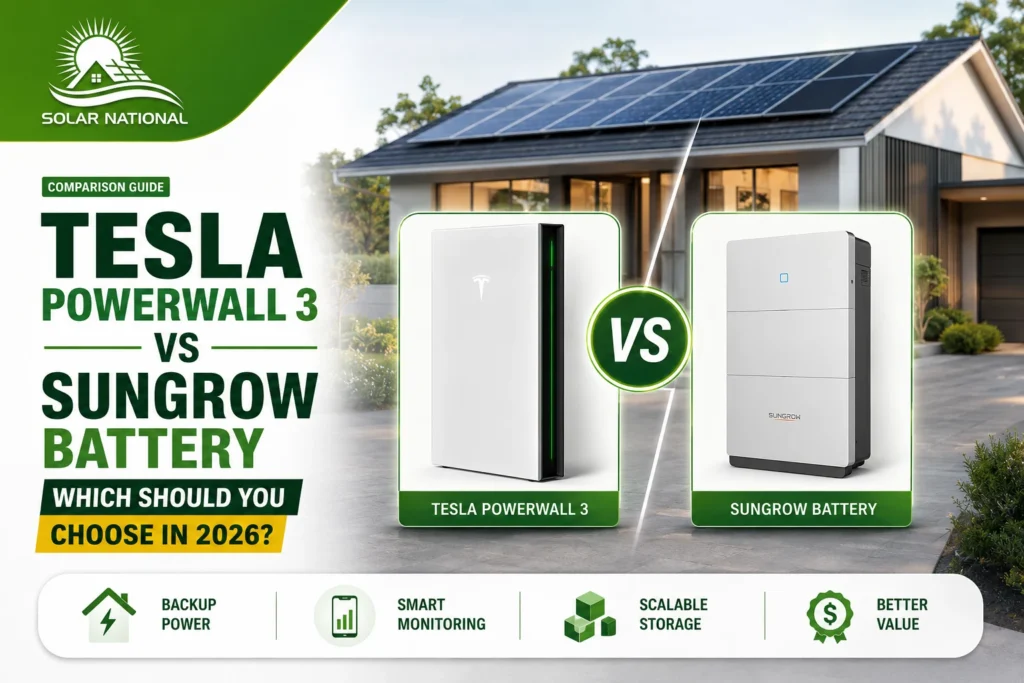
When homeowners start comparing options, two names come up again and again: the Tesla Powerwall 3 and the Sungrow battery. Both are proven, well supported and widely installed across Australia. But they are built around quite different philosophies, and the right choice depends on your home, your existing setup and your budget. Pick the wrong one and you could pay more than you need to, or miss out on features that matter for your situation. Here is an honest, side-by-side look at how they compare.
The quick verdict
If you want the short version: the Tesla Powerwall 3 is the premium, all-in-one option with a built-in inverter, class-leading power output and the best app experience, making it ideal for new installations and households that want simplicity and strong backup. The Sungrow battery is the flexible, value-focused choice, with a modular design that lets you size storage precisely and often a lower cost per kilowatt-hour, especially if you already run a compatible Sungrow inverter. Both are excellent. The rest comes down to detail.
Tesla Powerwall 3 at a glance
The Tesla Powerwall 3 is the latest generation of Tesla’s home battery, and its headline feature is integration. Unlike most rivals, it combines the battery and a full solar inverter in a single unit. That means a tidier installation, fewer separate components, and no need to buy a hybrid inverter on top.
It offers 13.5 kWh of usable capacity, lithium iron phosphate (LFP) chemistry for safety and longevity, and a round-trip efficiency of around 90 per cent. Where it really stands out is power: with about 11.5 kW of continuous output, it can run more high-draw appliances at once than almost any competing battery, which matters a great deal during a blackout. A single unit can typically keep an average home running for the better part of a day, and you can stack multiple units for more capacity. It comes with a 10-year warranty and Tesla’s polished monitoring app, which remains the benchmark in the category.
Sungrow battery at a glance
The Sungrow battery, most commonly the SBR high-voltage series, takes a different approach built around flexibility. It is a stackable, modular LFP system that scales from roughly 9.6 kWh up to 25.6 kWh, added in smaller increments. This modularity is its biggest strength: you can size the system closely to your actual needs and budget rather than buying capacity in large fixed blocks, and you can expand later as your usage grows.
Sungrow is one of the world’s largest inverter and storage manufacturers, and its batteries are known for high round-trip efficiency and strong value per kilowatt-hour. The key consideration is that the SBR battery is designed to pair with a compatible Sungrow hybrid inverter, which is a separate component. If you already have one, the battery represents outstanding value. If you are starting from scratch, you need to factor the inverter into the total cost. Like the Powerwall, it carries a 10-year warranty.
Head to head: the differences that matter
Capacity and scalability. The Powerwall 3 comes in fixed 13.5 kWh blocks, which suits most average to larger homes neatly but offers less granularity. The Sungrow wins on flexibility, letting you start smaller and scale up in steps, which is ideal if your needs are modest now but likely to grow.
Power output. The Powerwall 3 leads here, with higher continuous output than most rivals. If running air conditioning, an oven and other heavy loads simultaneously during a blackout is important to you, Tesla’s extra grunt is a real advantage. The Sungrow delivers solid, dependable output that covers everyday needs well, but it is not built to match Tesla’s peak muscle.
Inverter and installation. This is the crux of the comparison. The Powerwall 3 includes its inverter, simplifying the install and removing a separate purchase. The Sungrow needs a compatible solar inverter, which is either a cost saving (if you have one) or an added expense (if you do not). For a brand-new system, this narrows the price gap between the two considerably.
Price and value. On the sticker, the Powerwall 3 sits at the premium end. But because it bundles an inverter that the Sungrow does not, comparing raw battery prices is misleading. Once you account for the inverter Sungrow requires, the true difference shrinks. Where you already own a compatible Sungrow inverter, the Sungrow becomes the clear value pick per kilowatt-hour. Where you are building everything from scratch, the Powerwall’s all-in-one design becomes much more competitive.
Monitoring and ecosystem. Tesla’s app is widely regarded as the best in the business for tracking energy flows and managing backup. Sungrow’s monitoring is capable and clear, just less slick. If you are already in the Tesla ecosystem, perhaps with an EV, the Powerwall integrates neatly.
Which one suits which homeowner?
The Powerwall 3 is the better fit if you are installing a new solar and battery system together, you want maximum backup power for a larger home, you value simplicity and a single integrated unit, or you simply want the most recognised premium brand with the best app. Its strengths line up well with households that want a fit-and-forget, high-performance solution.
The Sungrow is the better fit if you want to tailor your storage size precisely, you are working to a tighter budget, you expect your energy needs to grow over time, or you already have a compatible Sungrow inverter, in which case the value is hard to beat. It rewards homeowners who want flexibility and the best price per kilowatt-hour.
Neither is objectively better. The right answer depends on whether you prioritise integrated power and simplicity, or modular flexibility and value. It is also worth remembering that the battery is only one part of the system. The quality of the solar panels, the inverter pairing and the installation all shape your real-world results, so it pays to look at the whole package rather than the battery in isolation. You can compare both alongside other options across the full solar battery range.
Don’t overlook the rebate window
Whichever battery you lean toward, the federal Cheaper Home Batteries rebate is a major factor in 2026. It applies a discount per usable kilowatt-hour of storage, taken directly off the installed price at the point of sale, which brings the net cost of both batteries down significantly. The catch is that the incentive is designed to taper over time, so the value is highest the sooner you install. If a battery is on your radar this year, it is worth understanding exactly what you qualify for. Our guide to the federal solar battery rebate explains how it works and how much you can expect to save.
Making the right call
Both the Tesla Powerwall 3 and the Sungrow battery are top-tier choices that will serve a Sydney home well for years. The decision comes down to your priorities: choose the Powerwall 3 for integrated power, simplicity and the premium experience, or the Sungrow for modular flexibility and value, particularly if you already run a Sungrow inverter.
As a Sydney-based installer working with both brands, Solar National can look at your home, your energy use and your existing setup, and give you a straight recommendation on which battery makes the most sense, along with a clear quote that includes the rebate. Book a free consultation and we will help you choose with confidence.
Frequently Asked Questions
1. What is the main difference between the Tesla Powerwall 3 and the Sungrow battery?
The Powerwall 3 is an all-in-one unit that includes a built-in solar inverter and comes in fixed 13.5 kWh blocks with high power output. The Sungrow battery is modular, scaling from around 9.6 to 25.6 kWh, but it requires a separate compatible Sungrow hybrid inverter. Tesla prioritises integration and power, while Sungrow prioritises flexibility and value.
2. Which battery offers better value for money?
It depends on your setup. The Sungrow generally offers a lower cost per usable kilowatt-hour, making it excellent value if you already have a compatible Sungrow inverter. The Powerwall 3 costs more upfront but includes an inverter the Sungrow does not, so for a brand-new installation the real-world price gap is smaller than the sticker prices suggest.
3. Can I add a Sungrow battery to my existing solar system?
You can, provided you have or install a compatible Sungrow hybrid inverter, which the battery is designed to pair with. If your current inverter is not compatible, you will need to factor in the cost of adding one. An installer can confirm compatibility with your existing system.
4. Which battery is better for backup power during a blackout?
The Tesla Powerwall 3 has higher continuous power output, so it can run more high-draw appliances at once, such as air conditioning and cooking, during an outage. The Sungrow provides reliable backup for everyday needs, but Tesla leads on peak power for larger or more demanding homes.
5. Are both batteries eligible for the federal battery rebate?
Yes. Both qualify for the federal Cheaper Home Batteries rebate, which applies a discount per usable kilowatt-hour off the installed price. The incentive tapers over time, so installing sooner generally means a larger discount. Your installer applies the rebate at the point of sale.